
 USA: +1 508 290 1604
  Sign in

QUESTION
- There are four parts to the Direct Care Project.
- There will be graded Project Check-ins that correlate to each part.
- Review the table below for overview and due dates with each topic.
- Carefully review the instructions, tutorials, templates, and rubrics for each of the four parts as you begin this Course Project.
- Contact your instructor with questions.
| Overview | Points | Due Date | Project |
|---|---|---|---|
| Part 1: Assessment: Check-In | 10 | Wednesday of Week 2 | Required, graded check-in on progress of assessing your choice of nursing certification. |
| Part 1: Assessment and Diagnosis | 200 | Sunday end of Week 2 | Assess the link between quality improvement of patient outcomes, clinical nursing certification, and leadership development. |
| Part 2: Planning: Check-In | 10 | Wednesday of Week 4 | Required, graded check-in on progress of planning and creating the presentation. |
| Part 2: Planning the Presentation |
160 | Sunday end of Week 4 | Create a presentation for your targeted population about the specific clinical certification including how it could impact patient outcomes and leadership. |
| Part 3: Implementing the Presentation |
Required | Schedule presentation Saturday of Week 5 through Saturday Week 6 | Presentation of PowerPoint to identified targeted population. Includes pre-survey, post-survey, and attendance form. |
| Part 3: Implementation: Check-In | 10 | Wednesday of Week 5 | Required, graded check-in on progress of implementing your presentation. |
| Part 4: Evaluation: Check-In | 10 | Wednesday of Week 6 | Required, graded check-in on progress of evaluation of your presentation and project. |
| Part 4: Evaluating the Project | 200 | Sunday end of Week 6 | Evaluate learning and reflect on project. |
Directions for Part 1
-
- Review the Direct Care Project Overview above.
- View the Direct Care Project Part 1 Tutorial (Click here to view) (Links to an external site.).
- Download the Direct Care Part 1: Assessment and Diagnosis template under Templates below.
- Please address the following areas on the provided template:
- State the clinical certification and target population including setting that were approved by your instructor in the Week 2: Direct Care Part 1: Assessment and Diagnosis Check-In.
- Thorough discussion of why this certification was selected in relationship to the selected setting
- Describe the criteria for selected clinical certification
- Process to obtain clinical certification
- Cost of application and testing
- Requirements prior to certification
- Examination description
- Renewal time and process
- Required items for renewal
- Provide APA reference for one peer-reviewed scholarly professional nursing journal article connecting patient outcomes, certification, and leadership skills.
- From Chamberlain Library
- CINAHL or ProQuest
- Note: Do not use CINAHL Guides or Evidence-Based Care Sheets
- Full Text only
- No more than 5 years old
- In English
- Peer-reviewed
- Include the permalink
- For more information on finding Permalinks in the Chamberlain Library, see Learn the Library and Finding Permalinks (Links to an external site.)
- Reference must be use APA format including author(s), year, article title, journal name, volume number, issue number, page numbers, italics, parentheses, punctuation, double line spacing, and hanging indent. Include DOI if available.
- From Chamberlain Library
- Summarize findings of article
- Summarize the key points of the selected peer-reviewed scholarly professional nursing journal article in one or two paragraphs.
- Be clear and concise.
- Discuss how patient outcomes in the selected setting could be improved by certified nurses.
- Discuss how certification can impact leadership skills in the selected setting.
- Identify a problem (diagnosis) based on your assessment
- Important: The problem you identify will be utilized in Parts 2, 3, and 4 of the Direct Care Project.
- Write the problem diagnosis (See template)
- Submit template through the Submit Assignment button on this page.
ANSWER
DIRECT CARE PROJECT PART 1 ASSESSMENT AND DIAGNOSIS
Directions: Prior to completing this template, carefully review Week 2: Direct Care Part 1 directions and all rubric requirements.
Assessment of Certification, Patient Outcomes, and Leadership
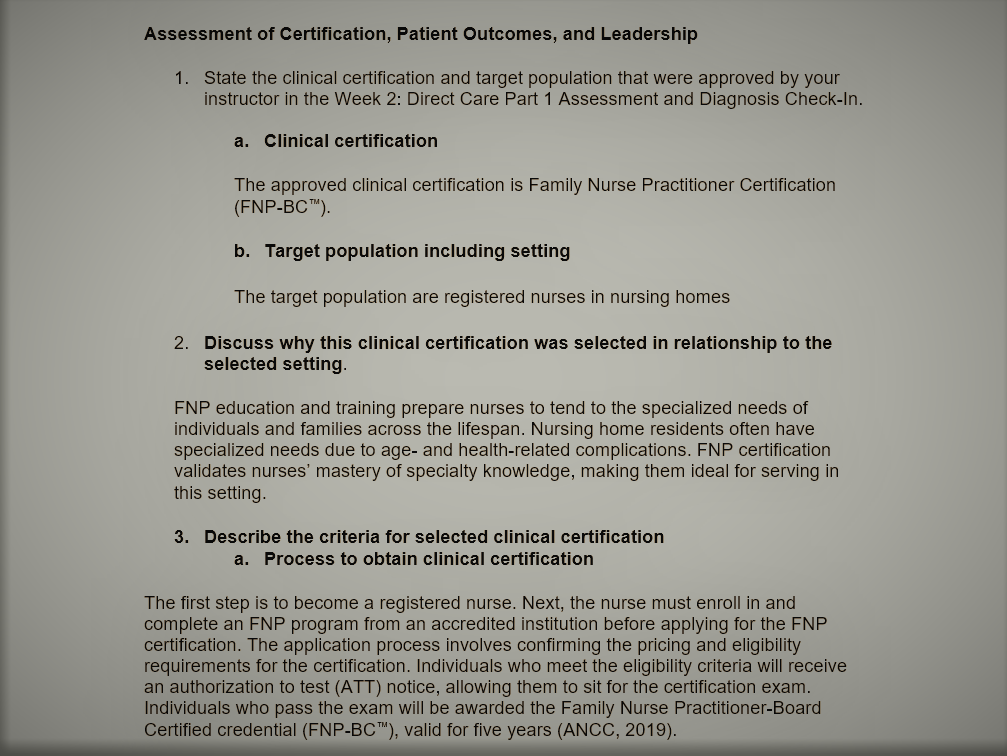
- State the clinical certification and target population that were approved by your instructor in the Week 2: Direct Care Part 1 Assessment and Diagnosis Check-In.
Clinical certification
The approved clinical certification is Family Nurse Practitioner Certification (FNP-BC™).
Target population including setting
The target population are registered nurses in nursing homes
- Discuss why this clinical certification was selected in relationship to the selected setting.
FNP education and training prepare nurses to tend to the specialized needs of individuals and families across the lifespan. Nursing home residents often have specialized needs due to age- and health-related complications. FNP certification validates nurses’ mastery of specialty knowledge, making them ideal for serving in this setting.
- Describe the criteria for selected clinical certification
Process to obtain clinical certification
The first step is to become a registered nurse. Next, the nurse must enroll in and complete an FNP program from an accredited institution before applying for the FNP certification. The application process involves confirming the pricing and eligibility requirements for the certification. Individuals who meet the eligibility criteria will receive an authorization to test (ATT) notice, allowing them to sit for the certification exam. Individuals who pass the exam will be awarded the Family Nurse Practitioner-Board Certified credential (FNP-BC™), valid for five years (ANCC, 2019).
Cost of application and testing
The application cost for non-members is $395 for the initial certification. Students members are eligible for discounts. American Association of Nurse Practitioners student members pays $290, while ANA (American Nursing Association) members will pay $295 (ANCC, 2019). Additional fees for special services may apply. If a candidate misses the 90-day testing window, they will pay a re-assignment fee of $100.
Requirements prior to certification
The eligibility requirement is an RN licensure. The candidates must hold a master’s degree, a Doctor of Nursing Practice (DNP), or a post-graduate certificate from a recognized and accredited FNP program. The candidates must have completed at least 500 FNP faculty-supervised clinical hours at the time of application (ANCC, 2019). They must also meet the minimum coursework requirements. These include content in disease management differential diagnosis and prescription of nonpharmacologic and pharmacotherapeutics. The candidate’s coursework must also entail three separate graduate-level courses: advanced pharmacology, advanced pathophysiology, and advanced health assessment. The examination board will review candidates’ official transcripts to verify whether they meet these coursework requirements.
Examination description
The examination has 175 questions, but the board only scores 150 questions. 25 out of the 150 questions are pretest questions, which the board uses to vet the candidates;. Hence, these pretests questions are not included in the final score. The exam is 3.5 hours long, but some examinations can last 4 hours. The examination assesses the nurse’s competency in four domains: assess, diagnose, plan, and evaluate.
Renewal time and process
The certification needs to be renewed every five years. Candidates must have a current RN license, an ANCC board certification, proof of completion of the 75-hour continuing education hours, and 25 hours of pharmacologic training to be eligible for license renewal. They then pay the renewal fee to get the renewed license. Nurses whose licenses have expired will need to meet the above eligibility requirements and pass a re-test before their licenses are renewed.
Required items for renewal
Candidates must have a current RN license, an ANCC board certification, and proof of completion of the 75-hour continuing education hours. The CE must also include 25 hours of pharmacologic training to be eligible for license renewal
- Provide APA reference for one peer-reviewed scholarly professional nursing journal article connecting patient outcomes, clinical certification, and leadership skills. See reference criteria under directions and include Permalink.
Kitto, S., Grant, R., Chappell, K., & Lundmark, V. (2017). The relationship between specialty certification of individual nurses and outcomes: developing a standardized taxonomy for research. JONA: The Journal of Nursing Administration, 47(5), 245-247. https://www.nursingcenter.com/wkhlrp/Handlers/articleContent.pdf?key=pdf_00005110-201705000-00001
- Summary of article (one to two paragraphs)
The article reports that there is a strong relationship between specialty certification and lesser rates of hospital-acquired infections, including ventilator-associated pneumonia and central line-associated bloodstream infections (CLABSIs) (Kitto et al.,2017). There is also evidence that nursing certification is associated with reduced falls (Kitto et al.,2017). Despite many studies reporting that specialty certification improves the quality of patient care, very few studies have demonstrated a causal relationship. The authors attribute these challenges to variations in certification standards. They indicate that there are many certifications that nurses can pursue, and each certification has its own standards. This lack of consistency or variations means nurses skills and expertise will be different, making it difficult to establish a causal relationship between nursing certification and patient care quality. The authors recommend further studies to examine how nursing certification is conceptualized and operationalized. These studies will yield new insights and guide the creation of an evidence-based certification taxonomy.
- How could patient outcomes in the selected setting be improved by certified nurses?
Certified nurses can improve patient outcomes in the nursing homes by providing clinical leadership. Certified nurses have strong leadership skills. Hence, they can effectively cope with various ethical issues, resolve conflicts related to patient care, and advocate for their patient’s needs and rights (Fukuda et al., 2020). These competencies can enhance patient satisfaction and experiences.
Besides management and leadership skills, certified nurses also have the clinical skills to develop policies and nursing care for the elderly with serious illnesses and specialized needs. They can also promote patient safety by enacting evidence-based care plans, thanks to their specialized clinical expertise and experience.
- How can clinical certification impact leadership skills in the selected setting?
Clinical certification promotes professionalism by mandating continuous professional development. The ongoing professional development ensures that the nurse stays abreast with best practices and advancements in the field. Nurses with such skills can be a source of innovative solutions to the organization, and they can contribute to creating an evidence-based organizational culture. FNP can educate nursing home staff on how to deal with complex situations and difficult problems. This support can improve the quality of nursing care at the organization (Fukuda et al., 2020). They can improve the organization’s communication culture, promote team dynamics, and create a work environment that supports positive health outcomes.
Problem Diagnosis Statement
Write a diagnosis based on the problem of knowledge deficit of certifications. Fill in the blanks below.
Example: Knowledge deficit r/t CNOR certification among operating room nurses (target population and setting) as manifested by wrong site surgeries (patient outcomes)
Knowledge deficit r/t FNP-BC™ certification among registered nurses as manifested by high pressure ulcers among nursing home residents.
References
ANCC. (2019). Family Nurse Practitioner Certification (FNP-BC) | ANCC. ANA. https://www.nursingworld.org/our-certifications/family-nurse-practitioner/
Fukuda, T., Sakurai, H., & Kashiwagi, M. (2020). Impact of having a certified nurse specialist in critical care nursing as head nurse on ICU patient outcomes. PLOS ONE, 15(2), e0228458. https://journals.plos.org/plosone/article?id=10.1371/journal.pone.0228458#sec017
Kitto, S., Grant, R., Chappell, K., & Lundmark, V. (2017). The relationship between specialty certification of individual nurses and outcomes: developing a standardized taxonomy for research. JONA: The Journal of Nursing Administration, 47(5), 245-247. https://www.nursingcenter.com/wkhlrp/Handlers/articleContent.pdf?key=pdf_00005110-201705000-00001
To get your original copy of this paper, please Order Now
Related Questions
Direct Care Project part 1 (ANSWERED)

