
 USA: +1 508 290 1604
  Sign in

QUESTION
Required Resources
Read/review the following resources for this activity:
- Textbook: Chapter 9, 10 (section 10.4), 11 (section 11.5), 13
- Lesson
- 1 primary source that corresponds with your selected topic (noted in the topic instructions)
- Minimum of 2 scholarly sources (in addition to the textbook)
Optional Resources to Explore
Feel free to review the library guide for scholarly sources and videos at the following link:
- Link (website): History Library GuideLinks to an external site.
Introduction
The purposes of each case study assignment include the following:
- To hone your abilities to research using scholarly sources
- To advance critical thinking and writing skills
- To compile a response to the prompts provided
- To explore a historical topic and make connections to change over time
Instructions
Pick one (1) of the following topics. Then, address the corresponding questions/prompts for your selected topic. Use at least one (1) documented example of the corresponding primary source in your writing.
Option 1: The American System, Transportation, and Communication
Read the following primary source:
- Link (website): Of Debates in Congress (Clay’s Debate of the American System in 1832)Links to an external site. (Click on “Next Image” to see all pages of the debate: pp.258-262.)
Then, address the following:
- Describe the idea of Henry Clay’s “American System.”
- Based on Clay’s economic vision of America, analyze how the American System would build the American market and economy?
- Analyze the role of mechanization and communication in the American System.
Option 2: The Indian Removal Act of 1830
Read the following primary source:
- Link (website): Transcript of President Andrew Jackson’s Message to Congress ‘On Indian Removal’ (1830)Links to an external site.
Then, address the following:
- Evaluate the rationale that President Jackson used in the removal of the Native Americans from east of the Mississippi River. Did the removal have the intended impact?
- Identify the responsibilities given to the President under the Indian Removal Act of 1830.
- Compare Jackson’s actions toward Native Americans in the context of his First Inaugural Address with the path of events during the Trail of Tears.
- Determine if the removal of the Native Americans from east of the Mississippi River violate the principles found in the Declaration of Independence?
Option 3: The Abolitionist Movement
Read the following primary source:
- Link (website): Declaration of Sentiments of American Anti-Slavery Society (1833)Links to an external site. (Click on arrows to view all images of the document. Click on plus and minus signs to enlarge or reduce size of images.)
Then, address the following:
- Assess if abolitionists were responsible reformers or irresponsible agitators?
- Explain how abolitionists upheld the Declaration of Independence as the foundation of antislavery and abolitionist thought.
- Assess the effect of the Gag Rule on the Abolitionist Movement.
- Analyze how the women’s rights movement would gain momentum from the antislavery movement.
Writing Requirements (APA format)
- Length: 2-3 pages (not including title page or references page)
- 1-inch margins
- Double spaced
- 12-point Times New Roman font
- Title page
- References page
- In-text citations that correspond with your end references
ANSWER
Option 1: The American System, Transportation, and Communication
Describe the idea of Henry Clay’s “American System
The American system was an economic model created by Henry Clay to help America become economically self-sufficient. The model had three main parts: protective tariffs to promote and protect the American industry, a national bank to strengthen trade, and infrastructural investments (internal improvements.) Some of the proposed “internal improvements” include the construction of roads and canals to facilitate trade and the creation of markets to support agriculture and advance settlement in the West. The bank centralized currency, while protective tariffs were designed to reduce competition and ensure American companies survived.
Based on Clay’s economic vision of America, analyze how the American System would build the American market and economy?
Before Clay’s economic vision, Martin and Nard (2013) report that the country’s economy mainly consisted of retailing, wholesaling, shipping, and brokerage. The government had only three banks, three bridges, and a few insurance and canal companies (Martin & Nard, 2013). Manufacturing firms were many, but only one had been successful (Martin & Nard, 2013). Skilled labor, especially in machine handling, was also inadequate. One of President Adam’s goals was to improve the country’s manufacturing sector.
According to Martin and Nard (2013), the number of commercial banks rose to 208 due the American System. There were only seven chartered business corporations in the country before 1775. By 1815, hundreds of companies had been chartered to construct bridges, canals, aqueducts, and banking facilities. The United States Senate reports that the government would obtain the funds to support Clay’s economic vision by selling public lands and tariffs. Martin and Nard (2013) indicate, “This system ―would raise tariffs, keep the price of public lands high, and use the proceeds to plan and construct a national system of internal improvements.”
Tariffs would improve the domestic market by raising the prices of imports. Consequently, American-made products would be cheaper, bolstering the domestic market. For example, the textile Industry significantly grew due to the series of tariffs enacted between 1816 and 1828. The Textile Industry in New England grew from 46 000 cloth yards to 142 000 between 1805 and 1830 (Martin & Nard, 2013). Massachusetts, the home of the cotton textile industry, also did exceptionally well due to tariff protectionism (Martin & Nard, 2013). This economic growth can be attributed to the tariffs that protected local companies from British competition. Corbett et al. (2016) indicate that President Adams imposed tariffs on up to 50% of the total value of all imported goods (p.248). These tariffs made the American market unattractive to the British companies, giving local companies an upper hand.
Another proposition of the American System is the internal improvements of roads and canals. Martin and Nard (2016) reveal that the growth in the manufacturing sector was caused, at least in part, by institutional changes. The institutional changes refer to the reduced transportation costs. Additionally, local markets that had been previously isolated would be easily accessible, making them part of the larger market.
Clay also envisioned a national bank system to facilitate commerce. Morriss and Nard (2011) indicate that the manufacturing sector in the United States also benefitted from the development capital market. According to the author, financial intermediaries and savings institutions were available to help manufacturers in their endeavors. A national bank would also promote smooth monetary flow and improve liquidity. It would also allow manufacturers to streamline operations by offering local manufacturers favorable interest rates.
Analyze the role of mechanization and communication in the American System?
Mechanization and communication played a crucial role in the American System. Mechanization improved production in both agricultural and industrial sectors. For example, many women shifted from handcrafting to factory production. Instead of spinning yarn on hand looms, these women moved their production to the factory, significantly improving their output. The output improved from 34 000 fabric yards to 43 000 yards in just nine months (Corbett et al., 2016, p.222). Due to this success, the textile factories increased to 878 in New England. Together, they hired more than 100 000 people and produced over 940 million yards of clothes (Corbett et al., 2016, p.222). Other economic sectors also started mechanizing, including leather tanning, shoe making, gun making, flour milling, clock making, etc. Increased output production improved the country’s economic growth through exports and imports. Surplus production boosted economic growth through imports and exports.
The American communication system was also vital. It united America with other regions. The postal system, phonographs, telegraphs, cameras, improved newspaper presses, and movies helped connect America. The telegraph facilitated long-distance communication, while the postal system helped businesspeople interact worldwide. Between 1815 and 1830, the number of post offices tripled. The cost of long-distance letters reduced from 25 cents to 3 cents due to these communication improvements (Martin & Nard, 2013). The new printing press helped publishers print more newspapers, which informed the public of national development. In other places in the U.S., businesspeople employed phonograph inventions to sell their products. Photographs preserved history while movies entertained Americans. Corbett et al. (2016) indicated that improved communication enhances business development, economics, and politics (P.232). Martin & Nard (2013) showed that this economic prominence was an emerging American system. “This development was genuinely national … the nation was a ‘technological community’ sharing a communication network and a common market environment” (Martin & Nard, 2013, p.191). The advanced communication system enhanced information sharing and rapid information distribution, which, in turn facilitated economic growth.
Option 2: The Indian Removal Act of 1830
Evaluate the rationale President Jackson used to remove the Native Americans from the East of the Mississippi River. Did the removal have the intended impact?
President Jackson’s rationale for removing Native Americans from their ancestral land was that their presence threatened the state’s sovereignty. However, evidence shows that the true motives behind Jackson’s anti-Native policies were racially-motivated. First, the Native Americans he sought to eradicate had adopted the American culture. They spoke English, farmed, practiced Christianity, and kept enslaved people like their White Counterparts (Corbett et al., 2016, p.258). Therefore, Jackson’s argument of paving the way for White civilization is contradictory because the Natives had adopted this culture.
Secondly, Jackson had a reputation for removing Native residents from their land. He fought against the Seminole in 1817 and the Creek in 1813. These wars made Jackson a national hero, but they also demonstrate his racism. A study by Valentine (2018) showed that personal agenda drove Jackson’s ethnic cleansing agenda. The author points out that Jackson’s tragic childhood nurtured his deep hatred and fury toward the Native tribes (Valentine, 2018). To sum up, Jackson’s rationale for removing Native tribes from their land was not a response to America’s call for state sovereignty, territorial expansion, or White civilization. His true motives were personal and racially motivated.
Yes, the removal had the intended impact. Jackson envisioned a White nation characterized by American Civilization and White-only settlement. Approximately 50 000 Natives relocated to Oklahoma after the passage of the Indian Removal Act (Corbett et al., 2016, p.450). This removal of Natives left acres of land for White settlement, mining, farming, and cattle ranching. Whites’ population in the Southeast region increased, and slavery expanded. This westward expansion continued even after the Civil War, and land promised to Indians was taken by the government through coercive and forced tactics. Treaties such as the Treaty of Medicine Lodge Creek, the Second Treaty of Fort Laramie, and the Treaty of Medicine Lodge Creek were created to confine Indians to remote reservations and Oklahoma and prevent further resistance from them.
Identify the responsibilities given to the President under the Indian Removal Act of 1830.
The primary responsibility of Jackson was to remove Indians from the existing states to unsettled lands. Some of the Natives went peacefully, but others actively resisted White encroachment. President Jackson relied on the military to forcefully evict resistors from their land. Jackson’s second role was to grant land west of Mississippi within the state borders to White Settlers.
The third role was the power to negotiate treaties to facilitate the removal of Indian tribes from the East of Mississippi. He was instrumental in negotiating nine of the eleven treaties that stripped southern tribes of their lands. He promised to grant land west of the Mississippi River to natives willing to give up their homelands in the East. He also incentivized their corporation by providing material and financial assistance to relocate to the new territory.
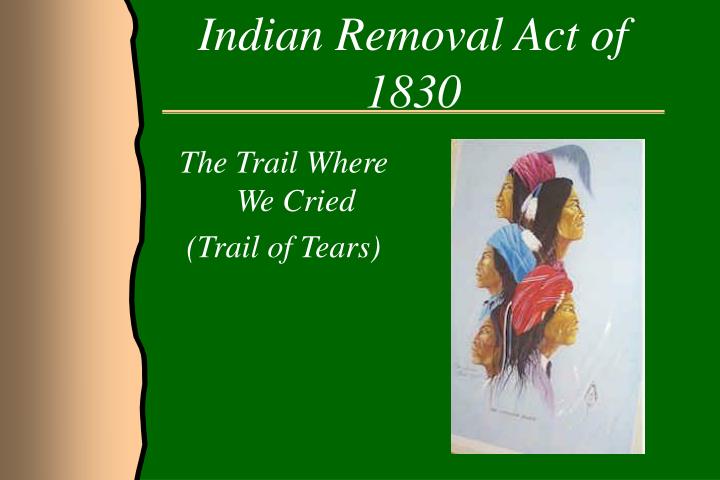
Compare Jackson’s actions toward Native Americans in the context of his First Inaugural Address with the path of events during the Trail of Tears.
In his first inaugural address, Jackson pledged respect for state power, American Indians’ rights, and limited executive authority. Some statements he made that credit the above statement include:
“In administering the laws of Congress I shall keep steadily in view the limitations as well as the extent of the Executive power, trusting thereby to discharge the functions of my office without transcending its authority” (Van-der-Voort, 2016).
“It will be my sincere and constant desire to observe toward the Indian tribes within our limits a just and liberal policy, and to give that humane and considerate attention to their rights and their wants which is consistent with the habits of our Government and the feelings of our people” (Van-der-Voort, 2016).
However, Jackson did not honor his pledge when he got into office. He changed the President’s responsibilities from an administrator to a popular tribune, reversing a history of administrative deference to legislative supremacy. For example, the Supreme Court ruled in favor of the Cherokees in the Cherokee Nation v. Georgia case. Instead of honoring the court ruling, Jackson turned to the military to facilitate the forced evictions. In his inaugural address, he claimed he would give “humane and considerate attention” to Indians’ rights and wants. However, this was not the case. During Jackson’s eight years in office, just one crucial legislation was enacted at his direction: the Indian Removal Act. It resulted in the bloody “Trail of Tears” (Van-der-Voort, 2016). The migration of American Indians from their ancestral homelands in the South to territories west of the Mississippi led to the death of about 4 000 Cherokees whom the Supreme Court had ruled in their favor.
Determine if the removal of the Native Americans from the East of the Mississippi River violates the principles of the Declaration of Independence?
Removing Native Americans from the East of the Mississippi River violates the Declaration of Independence principles. The first principle states that all persons are equal, but President Jackson’s actions demonstrate that he did not consider Native Americans equal to Whites. Most Americans believed Native Americans were savages, explaining they rejected them despite the natives adopting their culture. The second principle states that all humans have unalienable Rights, such as life, liberty, and pursuit of happiness. Jackson violated these rights because the forced evictions resulted in the loss of life.
Additionally, the natives were forced to give up the ancestral land to which they were entitled. The Act breached the third principle since Indians didn’t willingly consent to give ancestral lands to whites. Governments should act in the interests of the governed, but Jackson did not because he used coercion and force to strip Native Americans of their rights.
Option 3: The Abolitionist Movement
Assess if abolitionists were responsible reformers or irresponsible agitators?
The majority of the abolitionists were responsible reformers, but few of them were irresponsible agitators. The primary objective of most abolitionists was to eradicate slavery. The tactics they used to achieve this goal prove they were responsible reformers. They used radical approaches, e.g., moral tactics. They publicized slavery crimes and atrocities with the hope of to creating awareness on the evilness of slavery. This approach to transformation was a responsible one because it did not intend to stir hatred or conflict. Instead, it aimed to reason and appeal to the public’s moral principles and values.
Secondly, the abolitionists had a clear vision and stuck to it. They envisioned a world characterized by equality among all races. William Lloyd Garrison founded The Liberator Newspaper and Anti-slavery societies to end the practice. He believed that slavery perpetuated sinful practices among Americans and used moral suasion (appealing to the public’s conscience), evangelical Protestantism, power of petitions, and immediatism (the importance of immediate action) to campaign for the end of the practice (Corbett et al., 2016, p. 343). William Garrison stuck to this narrative and followed this responsible agenda throughout his endeavors.
Some abolitionists were also irresponsible agitators. For example, John Brown used violence to overthrow slavery. In the 1850s, John Brown and his supporters attacked the federal arsenal with the hope of capturing weapons and distributing them to enslaved people. His actions led to the eruption of guerilla warfare between anti-slavery and pro-slavery forces, leading to 150 deaths and significant property losses. Some abolitionists provided financial support, while others saw him as the embodiment of Jesus Christ (Corbett et al., 2016, p.372). However, John Brown’s violent plots and vision of a mass uprising ended when he was caught and hanged. Meanwhile, other non-violent abolitionists continued with their endeavors, which they had started in the 1830s. John Brown’s violent campaigns began in 1856 and ended in 1859, demonstrating that non-violent abolitionists did most of the anti-slavery campaigns. Therefore, most of the abolitionists were responsible reformers
Explain how abolitionists upheld the Declaration of Independence as the foundation of anti-slavery and abolitionist thought.
The abolitionist upheld the Declaration of Independence by fighting for racial equality. One of the principles of the declaration of independence is that all were created equal, and abolitionists’ goal was to achieve this racial equality.
Assess the effect of the Gag Rule on the Abolitionist Movement.
The gag rule blocked all petitions that involved the abolition of slavery. It prohibited Congress from addressing anti-slavery issues, a legislative setback for the abolitionist movement. The abolitionist movement could not make any legislative progress to end slavery until 1844, when the rule was rescinded.
The rule also increased hostility between anti-slavery movements and pro-slavery groups. Southerners used the gag rule as a proxy defense for slavery and its economic value, while anti-slavery representatives strongly defended it. These debates led to hostility between the two parties. Hoffer (2017) reveals that it caused virulent sectionalism and played a role in the Civil War and Southern secession.
Another study by Jenkins and Stewart (2020) indicates that the Gag Rule challenged abolitionists to double their efforts, which increased support from other Congressional members. The author states, “By 1844, popular pressure had become so great that many Northern Democrats, an important bloc of prior gag rule supporters, yielded to electoral pressure, broke party ranks, and voted to rescind the rule, thereby sealing its fate.” The Gag rule increased support for abolitionists in the Congress.
Analyze how the women’s rights movement would gain momentum from the anti-slavery movement.
The anti-slavery movement made many women realize that they, just like enslaved people, were captive in a male-dominated society. The anti-slavery movement inspired them to act and start campaigning for expanded roles. Because they were not allowed to participate in leading roles, female abolitionists (Sarah and Angelina Grimké) created separate societies (Corbett et al., 2016, p.346). The women used these societies to provide public lectures to men and women. These lectures raised questions about women’s role in public debates, laying the foundation for women’s rights movements.
References
Corbett, P. S., Janseen, V., Lund, J., Pfannestiel, T., Vickery, P., & Waskiewicz, S. (2016). US History. OpenStax.
Morriss, A. P., & Nard, C. A. (2011). Institutional Choice & Interest Groups in the Development of American Patent Law: 1790–1865. Supreme Court Economic Review, 19(1), 143-244. https://www.journals.uchicago.edu/doi/full/10.1086/664565
Hoffer, P. C. (2017). John Quincy Adams and the Gag Rule, 1835–1850. Johns Hopkins University Press. https://press.jhu.edu/books/title/11951/john-quincy-adams-and-gag-rule-1835-1850
Valentine, A. (2018). Andrew Jackson and the Indian Removal Act of 1830 personal agenda or territorial expansion. https://digitalcommons.murraystate.edu/sscw/1/
Van-der-Voort, T. (2016, April 22). First Words: Andrew Jackson, March 4, 1829 | Miller Center. Miller Center University of Virginia. https://millercenter.org/issues-policy/governance/first-words-andrew-jackson-march-4-1829
To get your original copy of this completed paper, please Order Now
Related Topics
Manifest Destiny and The Mexican War of 1846
Leading Causes of The American Revolution

