
 USA: +1 508 290 1604
  Sign in

QUESTION
Required Resources
Read/review the following resources for this activity:
- Textbook: Chapter 7, 8
- Lesson
- Link (website): Articles of Confederation (1777) (Links to an external site.)
- Minimum of 1 scholarly source (in addition to the textbook)
Initial Post
For the initial post, address the following:
- Pick two (2) issues of the Articles of Confederation and describe the main problems that the United States was faced with under the Federation government.
- Analyze two major debates (see textbook Section 7.4) by which the Constitution was created in the summer of 1787.
Then, address all of the following to your initial post:
- Discuss the ratification process of the Constitution of 1787.
- How did ratification lead to the formation of America’s first two political parties, the Federalists and Anti-Federalist?
- What were the major differences between the Federalist and Anti-Federalist, and who were the best-known members of each party?
ANSWER
Pick two (2) issues of the Articles of Confederation and describe the main problems that the United States was faced with under the Federation government.
One of the issues of the Articles of Confederation is that Congress could not tax or regulate foreign and interstate commerce. Under the Articles of Confederation, States were the only legal authorities allowed to levy taxes (“Articles of Confederation,” 2021). This provision forced the national government to depend on states to fund its expenses. However, most states neglected these duties, making the federal government underfunded. Consequently, the national government could not pay off debts or secure loans, compounding the country’s economic woes. The limited economic power also prevented it from settling territorial quarrels, taxation disputes, etc., making the country weak.
The second issue of the Article of Confederation (AOC) is that the national government could not raise an army. The AOC delegated these powers to state governments, most of which had their own military. The national government would have to rely on soldiers supplied by the state governments during war or rebellion. If the states failed to honor this request, the federal government would not have adequate resources to defend itself. This issue became apparent during the Shays rebellion. The national government could not gather enough military force to quell the uprising due to the restrictions the Articles of Confederation placed upon it. These issues led to a call to action for a stronger national government.
Analyze two primary debates (see textbook Section 7.4) by which the Constitution was created in the summer of 1787.
The primary debates discussed during the 1787 Philadelphia Convention were slavery and democracy. One of the discussed issues was whether or not to count enslaved people as part of a state’s total population (Corbett et al. 2016, p.184). Slaveholders wanted enslaved people to be counted alongside White people to augment their representation in the lower house. They argued that enslaving people came with significant liabilities; therefore, they were entitled to special consideration. These liabilities were tax-related. In 1775, Congress requested states to fund war by paying taxes (Corbett et al. 2016, p.184). It required each state to pay tax according to its total population, including the enslaved and the free. Counting enslaved people would reduce the tax burden of the slaveholders. In 1783, the Confederation allowed enslaved people to count as three-fifths of White people taxes (Corbett et al. 2016, p.185). This amendment gave slaveholders more political power and significant tax breaks. The Northerners supported the three-fifth compromise because it helped abolish slavery in the country. They believed that the ban on slavery balanced power between enslaved people and states.
Another issue that was debated was democracy. Some delegates believed that democracy promoted anarchy. The delegates wanted senators to be elected by state legislatures instead of direct election by the people to reduce this risk (Corbett et al. 2016, p.185). The representatives created the Electoral College as an additional safeguard against the dangers of democracy. The Electoral College was a mechanism that prevented the direct election of the president (Corbett et al. 2016, p.185). Under this mechanism, each state would have a specific number of electors. i.e., two senators and their representatives (Corbett et al. 2016, p.185). These electors were responsible for electing the president.
Discuss the ratification process of the Constitution of 1787.
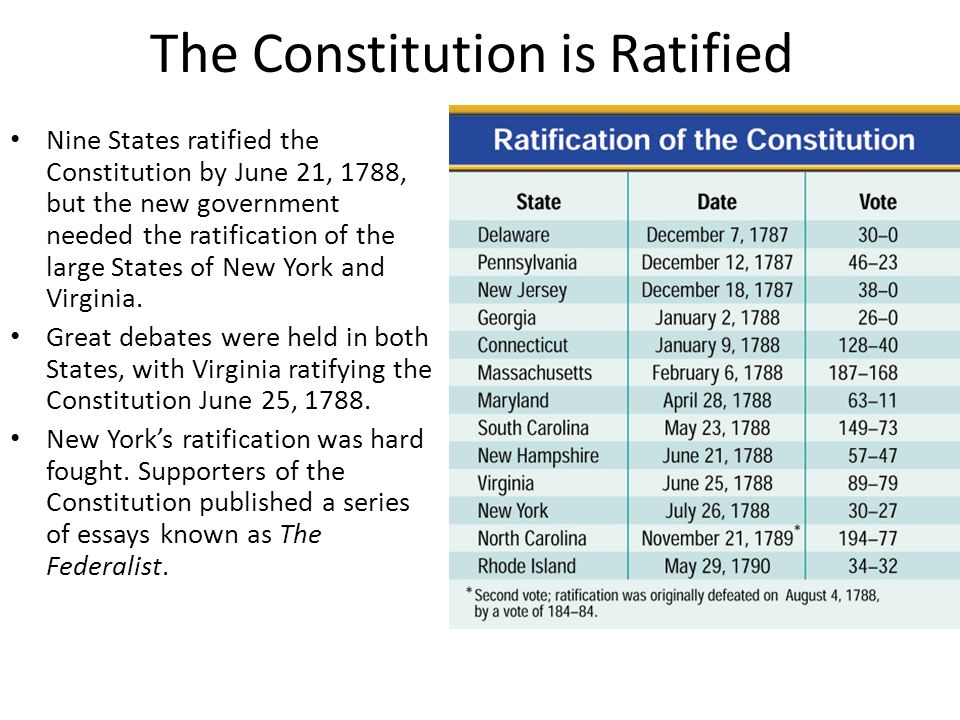
The Constitutional Convention ended in 1787, and the delegates agreed that each state would have a special ratifying convention before the final draft was implemented (University of Wisconsin, 2021). The delegates decided that if nine of the thirteen states approved the plan, they would implement the new Constitution. The first step in ratifying was to prepare the public for the new Constitution. The authors of the new Constitution devised a widespread campaign to sway public opinion to support their blueprint (University of Wisconsin, 2021). The central message of this campaign was that revising the Articles of Confederation would lead to a stronger central government. Newspapers in America were involved in this campaign (University of Wisconsin, 2021). They printed various publications to encourage the public to be receptive to the Convention’s proposal. In August, the delegates agreed that the votes of nine states were adequate to implement the new Constitution, declare war, ratify treaties, borrow loans, etc. (University of Wisconsin, 2021). They also decided that state conventions rather than state legislatures would do ratification. The delegates believed it was politically easier to acquire ratification through state convention than state legislatures.
The Congress formally received and read the blueprint on September 20. Congress secretly discussed whether to consider the Convention’s proposal. It then sent the Constitution to states for ratification. They agreed to deliver the Constitution to the states without congressional approbation as long as the states agreed to erase all references to the Constitution’s debate in the Congress’ Journals, including Lee’s Bill of Rights (University of Wisconsin, 2021).
After all state conventions, fewer than 30 000 men voted for the new Constitution (Corbett et al. 2016, p.187). The vote in New York was 30-27 in favor of the new Constitution. Massachusetts was 187-168(Corbett et al. 2016, p.187). In Virginia, the approval vote was 89-79, while Rhode Island’s was 34-32. The new Constitution only narrowly received approval, reflecting the fears of a centralized government.
How did ratification lead to the formation of America’s first two political parties, the Federalists and Anti-Federalists?
The two political parties arose due to conflicting visions and views of the American democracy and republic. The public had differing opinions over which government structure was the best, leading to the formation of two groups: those who supported the new Constitution (federalists) and those who opposed it (anti-federalists).
What were the major differences between the Federalists and Anti-Federalists, and who were the best-known members of each party?
One difference between the two groups is that federalists believed in a centralized government, while anti-federalists fiercely opposed this government structure. The federalists supported the 1787 constitution, while the anti-federalists opposed it. The federalists thought that a central government offered a better future. In contrast, the anti-federalists believed that centralizing power would strip the state governments of the ability to make independent decisions. They also thought the new Constitution was similar to the old corrupt regime of the British and that rich tyrants would run the government and monopolize Corbett et al. 2016, p.185). According to the Anti-federalists, these wealthy aristocrats wouldn’t represent ordinary citizens’ needs. Instead, they would use the government to protect their own interests Corbett et al. 2016, p.185). They also pointed out the new Constitution lacked a bill of rights. While anti-federalists thought the new constitution would not protect the citizens’ interests, the federalists believed these would be represented by their chosen representatives. Anti-federalists were also the first to raise concerns about the Constitution’s lack of Bills of Rights.
The best-known Federalists were John Jay, James Madison, President Washington, and Alexander Hamilton. The best-known Anti-federalist include Melancton Smith, Patrick Henry, and Richard Henry Lee.
References
Articles of Confederation (1777). (2021, April 9). National Archives. https://www.archives.gov/milestone-documents/articles-of-confederation
Corbett, P. S., Janseen, V., Lund, J., Pfannestiel, T., Vickery, P., & Waskiewicz, S. (2016). US History OpenStax.
University of Wisconsin. (2021, March 31). Ratification of the U.S. Constitution: An overview of the process. UNIVERSITY of WISCONSIN–MADISON. https://csac.history.wisc.edu/2021/03/31/ratification-of-the-u-s-constitution-an-overview-of-the-process/

