
 USA: +1 508 290 1604
  Sign in

QUESTION
Required Resources
Read/review the following resources for this activity:
- Textbook: Chapter 2
- Lesson
- Minimum of 1 scholarly source
Initial Post Instructions
If art lacks a clear definition, what criteria are used to determine what a work of art is? Please look at several works on any museum website to discuss what constitutes “art.” Some major museums include the Metropolitan Museum of Art, Art Institute of Chicago, or National Gallery of Art, or consider finding a local museum. The permanent collection is normally under the Collections link, but feel free to explore the entire website for your selection.
For the initial post, address the following:
- What approaches should we take in responding to a work of art?
- Select an example of art that fits your definition of art and provide an example of non-art (either from the site or in the world around you).
- Determine how line, color, texture, and/or composition are part of your definition.
ANSWER
What Is a Work of Art?
What approaches should we take in responding to a work of art?
The best approach to responding to a work of art is through perception. Martin and Jacobus (2019) indicate neither conceptual nor emotional responses can sum up a painting. According to the authors, we can only respond sensitively to a work of art if we perceive it correctly (Martin & Jacobus, 2019, p.14). Background information aids perception, while awareness of its artistic form will enable sensitive perception.
Art versus Non-Art
Example of a Non-Art (Image B)

How line, color, texture, and/or composition are part of your definition.
Image A is a flower painting misclassified as an art (Brachmann et al., 2017). There is no content or subject matter in Image A, and its elements lack unity. According to Martin and Jacobus (2019), a work of art must have a unified artistic form, i.e., line, color, texture, and composition, which provides insight into the subject matter. Image B has color, lines, edges, etc., but these elements have not been unified. They do not contribute to the image’s aesthetic value or reveal anything meaningful about the image’s subject matter. Hence, image B is not a work of Art.
Example of an Art (Image B)
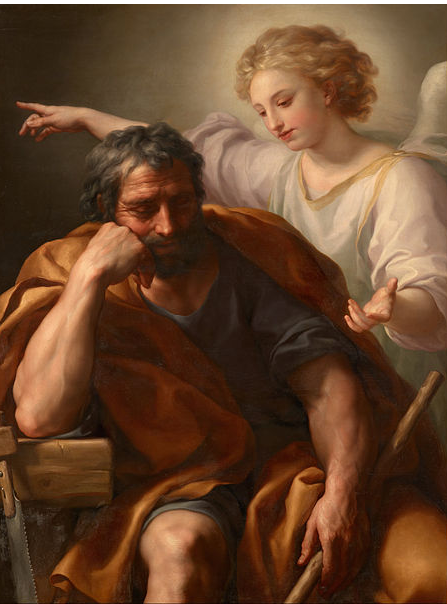
Artist: Georges de La Tour |Title: the dream of St. Joseph| oil on canvas| circa 1628 -1645
In contrast to image A, image B has a strong art form. The image shows Joseph, Jesus’ father, being visited by an angel. The lines on Joseph’s face depict a negative emotion, perhaps disappointment, worry, frustration, or sadness, while the angel’s face is calm. The angel is advising Joseph to leave Israel and seek sanctuary for the family in Egypt, explaining Joseph’s emotion. Joseph’s clothes are dark, while the angel’s clothes are bright. The background color behind each figure corresponds with their respective garments. Our interpretation of these details may differ, but they arouse participation and guide the viewer to the subject matter. These features make image B a work of art.
References
Brachmann, A., Barth., E., & Redies., C. (2019). Using CNN Features to Better Understand What Makes Visual Artworks Special. Frontiers. Psychol, 8. https://www.researchgate.net/figure/Examples-of-non-art-images-misclassified-as-art-A-C-and-art-images-misclassified-as_fig6_317389955
Martin, F. D., & Jacobus, L. (2014). Humanities through the Arts. McGraw-Hill Education

