
 USA: +1 508 290 1604
  Sign in

QUESTION
You will be writing a persuasive researched-based proposal addressed to a specific, named decision maker (that is, a person who has the authority to implement a recommended solution to a specified problem), The problem you will discuss is bullying within a school system.
Your proposal must offer an ORIGINAL solution to the decision-maker (not simply endorse a solution some other person or group has advocated), including, in this order:
1) Letter of Transmittal to the external decision maker OR Routing Slip to the internal decision maker via any required intermediate approval stops,
2) Title Page (listing the decision maker’s name and title, the title of your proposal, your name and position, and the date),
3) Executive Summary ,
4) Table of Contents (listing every section and beginning page number),
5) List of Illustrations (the illustration/graphics titles and page numbers where your illustrations/graphics appear –– NOT the actual illustrations themselves),
6) Introduction,
7) A series of Text sections separated by specific headings and including at least two integrated and sourced illustration/graphic aids (that is, incorporated on the same pages that discuss each) and in-text APA-format citations reporting external references that are listed alphabetically in the Works Cited page,
8) Conclusion(s),
9) Recommendations – a series of step-by-step actions for the decision maker to take to implement your proposed solution
10) An APA-style References page (so titled) Graphics/illustrations MUST NOT be on stand-alone pages, only on the page with text that refers to them specifically.
NO “clip art” accepted as one of the two required graphics/illustrations, but may be used in addition; graphics/illustrations must contribute something not explained by text alone.
Graphics/illustrations created by you should be labeled “(Author)”; those created by you from another source, such as statistics you found in an article, should be labeled: “(Author, derived from Jones 3)” where Jones is the author and the 3 is the page number where input for that graphic is found.
More than the maximum of any kind of reference can be used, if necessary – the additional sources just don’t count toward the total of eight in combination required.
“Internet” sources are references found ONLY on the Internet; a newspaper article obtained from the paper’s website counts as a newspaper article, not as an Internet reference.
Internet sources MUST be included on the References page, with each entry stating the author (if available), selection title, the home page title, the date of your access, the date of publication, in addition to the URL (in the order specified by the APA guidelines).
Researched sources in this proposal are used to
(1) prove that there IS a problem,
(2) prove that inaction will impact lives negatively,
(3) prove that the proposed solution is feasible, and/or
(4) prove that the recommended action will eliminate the problem.
PAGINATION:
Neither the Letter of Transmittal (or Routing Slip) or Title page contain page numbers.
The Executive Summary through the List of Illustrations are lower case Roman numerals.
The first page of the report is not numbered.
Page two of the report through the end of the document are labeled with Arabic numerals. Location on the page is up to the writer, but should be consistent. If the pagination feature of your word processor proves too troublesome, simply insert the page numbers manually (followed by a hard-page return to assure that the page numbers appear where they should).
Because each problem-solution is unique and each decision maker uniquely placed, there is no “model” for this assignment. The list of components and the order stated form the model for all such approaches to this assignment. The form of your proposal should be tailored to meet the needs of the specific decision maker and thus this proposal becomes a test of your ability to write managerial correspondence designed to change lives.
ANSWER
Letter of Transmittal
Betsy DeVos,
U.S Secretary of Education,
Department of Education Building, Washington, D.C
Dear Madam Secretary,
Subject: Transmittal of a proposal to effectively deal with the problem of bullying.
The enclosed Proposal is being submitted to the Department of Education in response to a request for proposals on how cases of bullying in schools can be minimized or eliminated. The proposal has been developed in light of the rising rates of school bullying and insecurity in the U.S.
The proposal has been developed after a thorough analysis of the current situation of security and levels of bullying in the U.S schools, including an analysis of data on bullying provided by the U.S Department of Education and other reputable institutions. In the attached proposal, the statistics of bullying in schools are provided and discussed, to elaborate on the current status of students’ security and welfare in our schools. The proposal proceeds to provide a number of recommendations for the effective response to the situation, providing a list of recommendations on how bullying can be eliminated in the country’s school system.
It is my hope that the proposal provided will provide a solution to the problem that our school system faces, and that the department finds the recommendations provided in the document relevant. I believe that the recommendations provided in the proposal, if implemented in the U.S education system, will assist in the control and eventual elimination of the bullying problem that schools and universities face today.
If any additional clarification or information is required, or if there is a need for me to respond to any questions, please feel free to let me know. My email address is provided at the beginning of this letter. I will be happy to be of assistance. Thank you in advance for your attention.
Regards,
[Name]
Betsy DeVos
U.S Secretary of Education
Proposal for the Control of Bullying in the U.S Education Sector
Executive Summary
Bullying is one of the major issues affecting the United States education sector. It is a serious issue for schools, students, and the families that students come from. Various stakeholders in the education sector are concerned and have been trying to reduce cases of bullying in U.S schools, including administrators, the Department of Education, policy makers, and educators. In order to deal with the bullying problem in American schools, it is important that the extent of the problem is measured, policies meant to reduce bullying are developed and implemented, and tracking of any form of progress towards the reduction of its prevalence is done. It is for this reason that the Department of Education and other institutions such as the National Center for Education Statistics (NCES) are committed to the provision of timely and reliable data on bullying statistics and monitoring of progress towards the reduction of bullying prevalence.
The Department of Education and the NCES are good examples of institutions that have played a huge role in the provision of context for understanding the bullying problem in the US education sector. Bullying has various negative effects on the education sector and on students. Bullying, whether at the hands of students or teachers, affects its victims negatively, resulting in them being unable to perform well at school or participate in other school activities. Bullying threatens the emotional and physical wellbeing of students at school and in society, negatively affecting their ability to interact with other students and to learn. Students who are bullied have poor memory, as bullying negatively affects the cognitive abilities of victims. They may also suffer from poor mental and physical health. For these reasons, bullying has to be addressed in the education sector to protect students and ensure their general wellbeing.
Various approaches to addressing bullying in the education sector have been suggested by researchers and the Department of Education, including fostering communication and mediation in schools to address the issue. In this proposal, the problem of bullying in the country’s education system is addressed, including the various definitions of bullying, what it involves, the extent of the bullying problem within schools in the United States, the various steps that have been taken to attempt to reduce the prevalence of bullying in the education sector, and the various statistics on bullying in the U.S education sector. A number of recommendations for the minimization and elimination of bullying in the education sector are provided in this proposal, with the process of implementation of the recommendations discussed. Data for the development of this proposal was obtained from the Department of Education, the NCES, various credible websites that monitor challenges facing the education sectors, and journal articles developed from research in the education sector.
Introduction
Bullying can be defined as the various acts of violence or unfair treatment against an individual. Bullying can either be done by a person or a group against an individual. Any form of psychological or physically violent behavior that is aimed at students, children, or young people is considered a form of bullying. Bullying is all about the abuse of power and the quest to appear superior to other individuals or peers and usually results in the victim of the bullying having low self-esteem. Bullying often results in the victims becoming closed off from their peers and family members, getting injured physically, and may even result in future psychological problems. An individual that is bullied, whether at home or at school, always feels threatened, insecure, unsafe, and uncomfortable, which affects their ability to interact with others and their performance at school or at home. Students that are bullied have a high possibility of experiencing anxiety, depression, loneliness, sadness, loss of interest, and shifts in eating and sleep patterns (O’Moore & Kirkham, 2001).
Bullied students begin to skip or miss classes and may even become school dropouts in cases of extreme bullying. The effects of bullying are likely to continue into the future of the victims, affecting them in their adulthood (Graham, 2016). Bullying may occur physically at school or through the internet and social media platforms. Bullying through messages on social media platforms is referred to as cyberbullying, and is a current issue across the world. Bullying within the school system in the United States and the rest of the world is a problem that affects millions of school students. According to Dracic (2009), out of every four children, one of them has been bullied at some point and more than 40 percent of the total number of students are bullied online; on social media platforms and emails. It is important that bullying is addressed in the school system to ensure that every student is provided with a conducive environment for learning.
Bullying within the U.S School System
Forms of Bullying
Bullying within schools occurs in different types or forms. The common forms of bullying are emotional bullying, verbal bullying, cyberbullying, and physical bullying (Menesini & Salmivalli, 2017). Physical bullying involves any form of unwanted and unwarranted physical contact between a bully and a victim. Physical bullying can be easily identified since it can be observed physically. Physical bullying includes acts such as inappropriate touching, fighting, headlocks, hazing, kicking, poking, punching, pulling hair, pranking, teasing, tickling, threatening, pushing, and the use of improvised or actual weapons on individuals. Emotional bullying refers to any form of bullying (physical, cyber, or verbal) that has a negative effect on the victim’s emotional wellbeing and psyche. Emotional bullying includes acts such as defamation, spreading malicious rumors about an individual, ignoring individuals on purpose or pretending that they do not exist, making people gang up against others, making fun of an individual, belittling, and making hurtful statements about an individual.
Verbal bullying refers to all acts of making slanderous accusations and statements that cause individuals to suffer from emotional distress and shame. Examples of verbal bullying are making negative comments on the looks of an individual, their body, or how they look; harassing an individual verbally; directing foul statements at an individual; deriding an individual’s name; verbally tormenting a person; verbal threats; mocking; belittling; inappropriate sexual comments or statements; and taunting. Cyberbullying is the most rampant form of bullying or harassment in the United States school campuses. It is also the quickest growing type of bullying in the world. More than 40 percent of students in the U.S have been bullied online in the past (Dracic, 2009). Cyberbullying is the intentional aggressive behavior, on the internet and social media platforms, where individuals or groups of people hurt others who are unable to defend themselves, by making statements and comments that are slanderous in nature (Menesini & Salmivalli, 2017). It occurs through computers and cellphones, through text messages, online social chatrooms, blogs, and social media platforms such as Facebook and Twitter.
Cyberbullying easily goes undetected as a result of the lack of authoritative supervision online. It is also the most anonymous types of bullying since the bullies often pose as someone else (Kowalski & Giumetti, 2017). Most students who are bullied physically or verbally at school are also bullied over the internet, as most of the peers that bully them at school are also on social media platforms and have their cellphone contacts. The advancement and increased reliance on social media and the internet have resulted in reduced cases of physical bullying in schoolyards but increased the rates of cyberbullying. Many cyberbullies are usually repeat offenders, with male students having a higher likelihood of being cyberbullies than female students. Cyberbullying is rampant in the United States and can be used on children when they are alone since they are always on their computers and cellphones.
Causes of Bullying
Bullying in school campuses occurs as a result of various underlying causes. These include social norms, gender norms and stereotypes, and other structural factors. Gender norms that are discriminatory, for instance, shape subservience of girls and dominance of boys, which results in the perpetuation of such norms through violence and bullying (Rigby, 2008). The inequality that exists in society on the basis of gender worsens the problem. Bullying sometimes occurs where teachers mistreat their students, rather than between students. This is sometimes caused by the societal norms that support the superiority and authority of teachers and instructors over students, as these norms sort of legitimize the utilization of violence as a way of instilling discipline and maintaining control at school. Students face a lot of pressure to live by gender and societal norms. While most students choose or are able to conform to these norms, others choose not to. The students who do not live in accordance with gender and societal norms are usually punished by violence and bullying at school and online. For instance, students who refuse or fail to conform to binary gender classifications are bullied online and verbally in school campuses for being different.
Schools and teachers may also show students how to be violent and trigger bullying through the use of textbooks, curricula, or teaching practices that are discriminatory. Power imbalance and gender discrimination at school and in the society encourage practices and attitudes that uphold gender inequality norms, tolerance to violence, and bullying. Structural factors and environment also contribute to bullying in schools. Factors such as the lack of proper and effective anti-bullying laws and practices, idleness, and boredom in schools contribute to bullying in many school campuses. When students do not have adequate work and activities to keep them busy and occupied, they may engage in nonconstructive activities such as bullying (Jacobsen & Bauman, 2007). The presence of antibullying practices that are ineffective or the lack of any anti-bullying laws encourages bullying in schools. Teachers and other staff members may fail to care enough to ensure that students do not bully others, which encourages increased rates of bullying. In addition, schools usually work within various social and structural contexts. These contexts sometimes reflect in school environments that do not protect students from bullying.
Schools that operate in communities where sexual and physical violence are prevalent or rampant often have more cases of bullying and violence, especially physical bullying acts such as inappropriate touching, fighting, and use of weapons. Schools that operate in communities where weapons, gangs, and drugs are the culture and way of life have high cases of physical bullying. Bullies are often individuals who have been bullied in the past or students that are going through difficulties at home (Rigby, 2008). Students who come from well-knit families that show them love and care do not feel the need to hurt others. However, those that come from broken families and homes that are affected by domestic violence and similar problems bully their peers to get attention and feel powerful. These individuals feel neglected and unloved, often projecting their frustrations on others. They take their pain or hurt on their peers who appear weaker than they are.
Bullying Prevalence in U.S Schools
Figure 1.0: The Percentage of school going children aged 12–18 who were bullied on school grounds from the year 2005 to 2013.
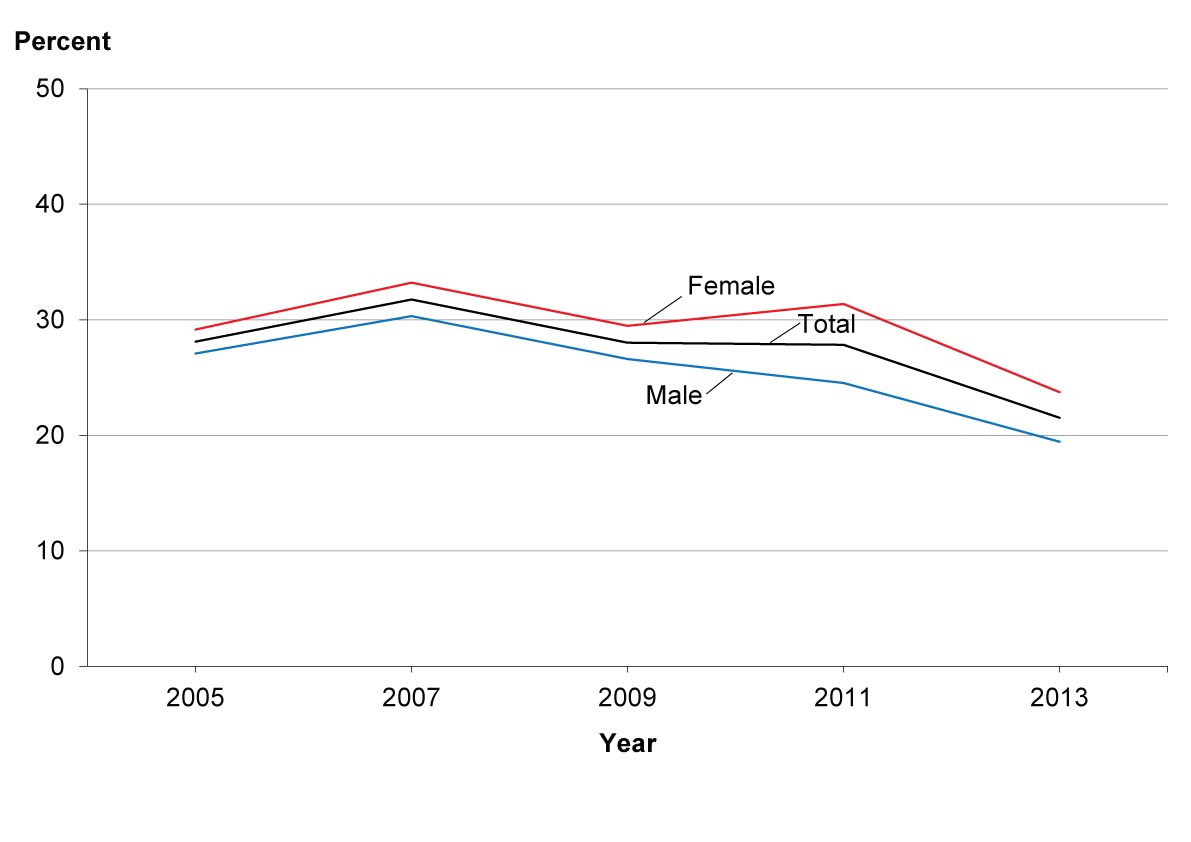 Obtained from the U.S. Department of Justice, Bureau of Justice Statistics, School Crime Supplement (SCS) to the National Crime Victimization Survey (2005-2013).
As observed in the above diagram, more than 20 percent of students were bullied at school premises during the 2013 school year. This data represented traditional bullying or other forms of bullying other than cyberbullying. The number of female students that are bullied remains higher than that of male students, and male students have a higher likelihood of bullying their peers than female students. It can be observed that traditional bullying has been decreasing over the years, as the percentage of bullied students in 2013 was lower than the percentage in all the prior years. While the percentage of bullied students seems to be reducing (U.S. Department of Education, 2015), a percentage of more than 20 percent is still too high.
Figure 1.1: Percentage and Number of students aged between 12 and 18 that were bullied on school grounds between the year 2014 and 2015.
| Type of bullying reported | Estimated number of students | Percent of students |
| Total bullied and not bullied | 24,243,000 | 100.0 |
| Bullied | 5,041,000 | 20.8 |
| Made fun of, called names, or insulted | 3,223,000 | 13.3 |
| Subject of rumors | 2,968,000 | 12.2 |
| Threatened with harm | 941,000 | 3.9 |
| Pushed, shoved, tripped, or spit on | 1,235,000 | 5.1 |
| Tried to make do things they did not want to do | 607,000 | 2.5 |
| Excluded from activities on purpose | 1,220,000 | 5.0 |
| Property destroyed on purpose | 440,000 | 1.8 |
| Not bullied | 19,202,000 | 79.2 |
Obtained from the U.S. Department of Justice, Bureau of Justice Statistics, School Crime Supplement (SCS – Version 1) to the National Crime Victimization Survey, 2015.
As observed in the above table, more than 1 out of every 5 students had been bullied (20.8 percent) in the school year 2014-2015. In addition, the survey found that about 33 percent of the bullied students were bullied once or twice every month. Just as with the previous survey, a higher percentage of students that reported being bullied were female. Students reported being bullied inside classrooms, hallways, and in the locker rooms (NCES, 2016). The reasons for students being bullied included gender, physical appearance, disability, sexual orientation, and religion.
Conclusion
Bullying is one of the main challenges affecting the education sector in the United States (Jacobsen & Bauman, 2007). It affects the self-esteem of children and students. The school life of an individual is very important as it affects how they feel about themselves and carry themselves in adult life. Individuals who are bullied in their school years begin to dislike themselves and be conscious of their imperfections. They develop low self-esteem and may be withdrawn from society and their peers (O’Moore & Kirkham, 2001). They engage in unhealthy activities such as overeating and skipping classes. They may close themselves up from their families and lead an unhealthy lifestyle, often engaging in drug abuse as an escape. It is, therefore, important to address the issue and find ways of effectively dealing with it.
Recommendations
In order to effectively deal with the bullying problem in the U.S school system, it is recommended that the following procedure be adopted and executed in American schools:
- Understanding bullying and training students on how to effectively respond to or confront bullying. It is important that teachers and instructors understand the various bullying behaviors and help their students understand and confront the problem. Teachers should be trained on how to recognize the traits of bullies so that they can assist them through counseling and giving them the care and attention that they need. Students should be provided with education on how to handle bullies and report bullying to ensure that they do not suffer the negative effects of bullying. Students should be provided with counseling to ensure that they are able to deal with family problems and express their emotions in ways that do not affect their peers negatively. It is also important that students are educated on the negative effects of bullying especially in adult life, so as to discourage bullying. When students are aware of the negative effects that bullying has on the victims, they will avoid bullying their peers and those who cannot defend themselves.
- The next step is to come up with a set of regulations and rules that protect students from bullying and violence. While some schools have rules against bullying and harassment, the rules are often ineffective since there is no monitoring by teachers and security personnel. Monitoring should be done to ensure that students do not bully each other. The U.S Department of Education should develop a standard set of rules and regulations that all schools should adopt to protect students from bullying by teachers and peers.
- Students’ online activity should be monitored to minimize cyberbullying. The management of schools should ensure that all student activity on the internet, including social media and messages that students send to each other on social platforms, are monitored to an extent so as to identify elements of cyberbullying and deal with them. students should be trained on how to identify cyberbullying and provided with a way of reporting it to the relevant authorities.
- Establish an anti-bullying program in all American schools. A good anti-bullying program should seek to assist victims of bullying and prevent bullying of students. The program should also educate teachers on how to inform students about bullying and how to avoid it. The teachers and parents have to play their roles in the control of the problem, by providing the necessary care and assistance to students and dealing effectively with bullies. It is important that parents are involved in the anti-bullying program, as students may also be bullied at home, especially through the internet. The U.S Department of Education should develop a standard anti-bullying program for schools, which may then be customized to meet the specific needs of schools before implementation.
- Ensure that schools have an adequate number of teachers and security personnel on campus. Most of the time, schools do not have enough teachers to take care of students and keep students occupied with class work. This leaves students idle, which gives them time to engage in bullying and other nonconstructive activities. Ensuring that every school has an adequate number of teachers and instructors will ensure that students are busy and occupied, leaving them without any idle time to engage in bullying and violence. By ensuring that school campuses have adequate security personnel, students will be secure within school campus grounds and physical forms of bullying such as fighting and inappropriate touching will be avoided.
Through the implementation of the above five recommendations, the problem of bullying in the school system will be effectively managed to reduce cases of bullying in the school campuses and at home. In addition, it is important to ensure that students are protected at home and in society, as bullying also occurs outside school.
References
Jacobsen, K., & Bauman, S. (2007). Bullying in schools: School counselors’ responses to three types of bullying incidents. Professional School Counseling, 11(1), 1-9.
Rigby, K. (2008). Children and bullying: How parents and educators can reduce bullying at school. Blackwell Publishing.
Dracic, S. (2009). Bullying and Peer Victimization. Materia Socio Medica, 21(3), 216-219.
O’Moore, M. M., & Kirkham, C. C. (2001). Self-esteem and its relationship to bullying behavior. Aggressive Behavior, 27(4), 269-283.
Menesini, E., & Salmivalli, C. (2017). Bullying in schools: the state of knowledge and effective interventions. Psychology, health & medicine, 22(sup1), 240-253.
Graham, S. (2016). Victims of bullying in schools. Theory into practice, 55(2), 136-144.
Kowalski, R. M., & Giumetti, G. W. (2017). Bullying in the digital age. In Cybercrime and its victims (pp. 167-186). Routledge.
National Center for Education Statistics. (2016). Indicators of School Crime and Safety: 2015. U.S. Department of Education. Retrieved July 05, 2019 from https://nces.ed.gov/fastfacts/display.asp?id=719
U.S. Department of Education, (2015). New data show a decline in school-based bullying. Retrieved July 05, 2019, from https://www.ed.gov/news/press-releases/new-data-show-decline-school-based-bullying

