
 USA: +1 508 290 1604
  Sign in

PART I: INTRODUCTION TO HR
Duties of an HR Department
- Ensuring compliance with all the relevant labor laws and regulations.
- Recruiting and training all new employees (Noe, Hollenbeck, Gerhart, & Wright, 2017), which involves advertising open positions, conducting interviews, hiring the best and talented employees, and setting aside adequate time to train new employees.
- Record keeping and ensuring tax compliance – the HR department ensures that all income, expenses, purchases, and sales records are properly kept. Employee records, business licenses, inventory statistics, and insurance records are also maintained by the HR department.
- Dispensation of employee benefits and payroll.
- Management of employee-employer relations – the HR department is responsible for dispute resolution between the employer and the employees. In addition, the employees of an organization bring any relational problems or issues to the attention of the HR department for speedy resolution.
- Developing employee performance improvement plans – the HR department is responsible for setting up PIPs within an organization, which are program aimed at improving the performance of the workforce.
Benefits of HR Management’s Primary Functions
- Recruitment (Noe et al., 2017): By conducting the recruitment of employees for an organization, the HR department fulfills the staffing needs of the organization, ensuring that all the operations of the organization proceed without delays. The HR department also ensures that qualified and talented employees are hired through the recruitment and interviewing processes.
- Safety: By fulfilling the safety function, the HR department ensures that an organization invests in, and develops a proactive safety culture. This ensures that the employees of an organization work efficiently and protect themselves from accidents, injuries, and other issues.
- Employee Relations: By managing employee relations within an organization, the HR department helps ensure that employee disputes are resolved and that the good relationship between the employer and the employees is maintained. This way, the operations of the company continue uninterrupted and the employees remain highly motivated.
- Compensation and benefits (Noe et al., 2017): The HR department ensures that all the benefits of the employees are administered in a fair manner and that the employees are motivated. This function also ensures that the employees of an organization feel valued and appreciated for their input and contribution towards organizational goals.
- Compliance: Bye ensuring compliance with labor laws, tax obligations, and other regulations, the HR department ensures that an organization avoids lawsuits that could damage its reputation and affect its performance negatively. This function ensures that an organization abides by the law.
- Training and development: This function ensures that an organization acquires a highly-performing workforce that is well-equipped to meet its obligations and contribute to the success of the organization. This function also ensures that new employees are inducted and trained to become aligned with the culture and the goals of an organization.
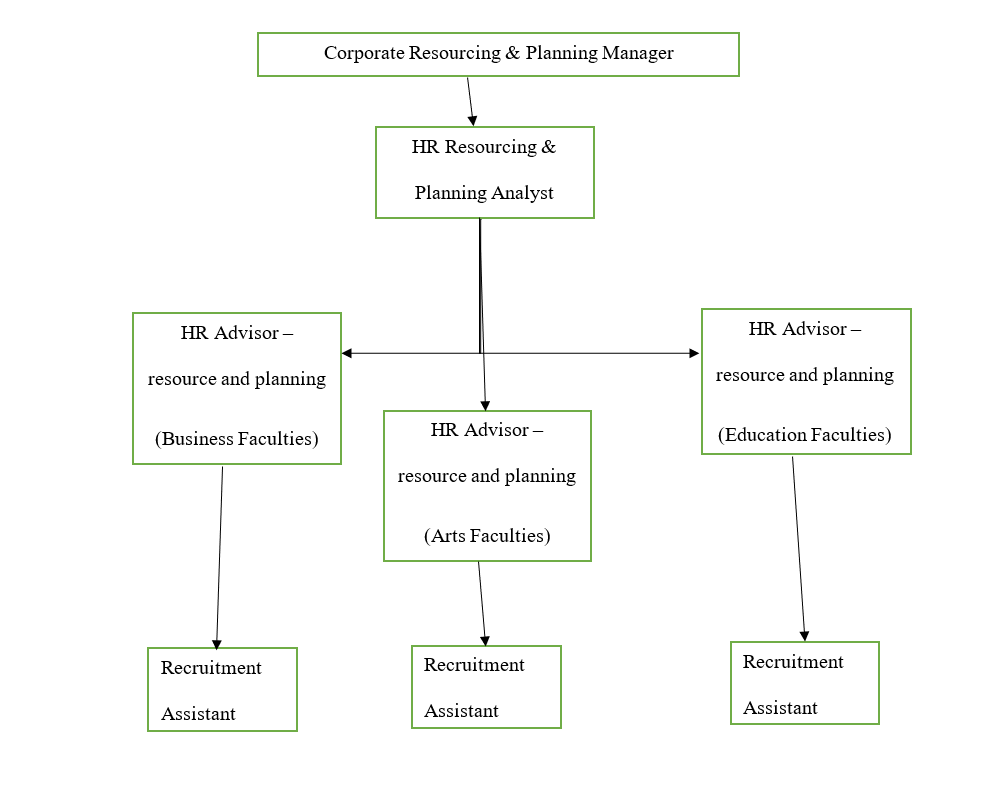
HR Department Structure
History of Human Resource Management
- In the late 18th century, the welfare and the safety of the workers was not a concern for management (Deadrick & Stone, 2014). All that they required was the contribution of the workers – what they had to offer. There was a clear need for the welfare of the workers to be taken care of.
- In the early 1800s, the need for employee welfare management was met through the development of the “welfare to work” systems that were meant to improve the social and working conditions of employees (Deadrick & Stone, 2014). These systems set the pace for employee relations management, where workers eventually benefited by receiving housing, apprenticeship, insurance, and pensions.
- The development of manufacturing in the 1900s came with the need to improve the productivity and the efficiency of employees. This led to the development of labor unions that advocated for better working conditions and were in charge of managing labor relations.
- Strategic human resource management has been developing and evolving since the 1980s (Deadrick & Stone, 2014). The HRM function has evolved to become a strategic partner in organizations, and organizations are fully aware of the important role that HRM plays (Paauwe & Boon, 2018).
Why HRM is Necessary
Human resource management is responsible for the management of employee issues such as compensation, organization development, performance management, employee wellness, safety, benefits, the motivation of employees, and training. It also plays a strategic role in organizations through the management of workplace culture, the people within an organization, and the environment (Paauwe & Boon, 2018). An organization is able to enjoy smooth operation and high productivity with proper management of employee relations and issues.
PART II: THOSE THAT WE LEAD
Types of Personalities
- Wallflowers: These are people who prefer to work alone rather than work in a group (Furnham, 2002). They are comfortable working in solace and avoid team projects as much as they can. They may be hard workers, but they may get comfortable in their own space and negatively affect productivity. A leader should provide these workers with a quiet, productive workspace to help raise their output.
- Achievers: These are employees who always strive for excellence in all that they do (Furnham, 2002). They have a strong work ethic and largely contribute to the success of an organization. A leader does not need to supervise these people. All they need is an opportunity to advance their goals. The leader should push them with more challenging roles and projects.
- Narcissists: They work best alone and are the hardest working employees. However, they can burn a lot of bridges along the way. They have no problem pushing past other employees to accomplish their goals. A leader should encourage such employees to try and relate with others better.
- Energizers: These people are “the life of the party” in the workplace. They come up with new ideas and are willing to work with others. A leader needs to ensure that these people are kept focused on work.
- Optimists: These are the people that all the other employees vent to. They know how to empathize and are always optimistic. They are able to motivate new employees and encourage them to perform better. A leader should allow them to share their positivity, but should from time to time remind them of the sometimes-harsh realities of business. Too much optimism can be blinding.
People-related Issues within Organizations
- Poor chemistry between workers and supervisors.
- Improper employee performance appraisal.
- Sexual harassment issues.
- Long working hours.
- Diversity within the workplace.
Examples of Personnel Issues
- Ability and Skills: The lack of effective leadership in an organization as a result of the lack of leadership skills.
- Role Perception and expectations: Disgruntled employees as a result of not getting promoted or not getting salary increments.
- Lack of Resources: Unhappy and demotivated employees as a result of poor pay.
- Low motivation or poor effort: Poor employee performance and productivity as a result of demotivation.
Addressing Motivation Issues
- Using compensation and employee benefits
- Provision of training to improve skills.
- Promotions and other forms of rewards.
Using Rewards to Motivate Employees
- Make sure that employees are aware of how to earn rewards so that they work towards earning them (Noe et al., 2017).
- Ensuring that employees look at rewards as worth their effort so that they work hard to get them.
- Using both financial and non-monetary rewards in order to acquire a strong emotional pull and greater aspiration from employees (Noe et al., 2017).
Motivational Strategies
- Job enlargement: A supervisor getting promoted to middle-level management. The individual will be highly motivated to perform even better and rise to top-level management.
- Increase challenges: An employee working as a machinery operator in a production company getting assigned supervision roles and new production targets. This employee will be motivated to fulfill his new roles and achieve recognition or promotion.
- More autonomy: A production supervisor getting the authority to decide how production will proceed, the arrangement of the shift, and the daily targets. The supervisor will be motivated as a result of the increased autonomy or the freedom to decide how work will be done.
Social Dynamics for Motivation
By establishing a culture that is based on ethical values such as integrity and accountability, the employees of the school can be motivated to perform better. Such a culture evoked the desire to contribute to organizational improvement and success.
Leadership Matters
In the community where I live, a church leader who is highly respected in the area came up with a small group of young people meant to carry out environmental conservation activities and activities that involved giving back to the community. By assigning each one of us duties and providing us with a monthly allowance as a token of appreciation, each of us was highly motivated to accomplish the goals that he set for the group.
PART III: THEORY IN PRACTICE
Maslow’s Theory
Maslow proposed that an individual’s motivation is developed from the individual’s attempt to fulfill or meet the five primary types of needs – physiological needs, safety needs, social needs (belongingness), esteem needs, and self-actualization (Healy, 2016). This theory can be used in the development of employee motivation strategies. For instance, in order to motivate an organization’s workers, a manager may decide to meet their needs by providing good pay (physiological), ensuring workplace safety and security (safety), developing work teams (belongingness), developing job descriptions that list the duties and responsibilities of each employee (esteem), and providing training and development programs for the employees (self-actualization).
References
Deadrick, D. L., & Stone, D. L. (2014). Human resource management: Past, present, and future. Human Resource Management Review, 3(24), 193-195. https://www.researchgate.net/publication/259657771_Deadrick_D_L_Stone_D_L_2014_Human_resource_management_Past_present_and_future_Human_Resource_Management_Review
Furnham, A. (2002). Personality at work: individual differences in the workplace. Routledge. https://doi.org/10.4324/9780203134122
Healy, K. (2016). A Theory of Human Motivation by Abraham H. Maslow (1942). The British Journal of Psychiatry, 208(4), 313-313. https://doi.org/10.1192/bjp.bp.115.179622
Noe, R. A., Hollenbeck, J. R., Gerhart, B., & Wright, P. M. (2017). Human resource management: Gaining a competitive advantage. New York, NY: McGraw-Hill Education. https://www.mheducation.com/highered/product/human-resource-management-gaining-competitive-advantage-noe-hollenbeck/M9781264188895.html
Paauwe, J., & Boon, C. (2018). Strategic HRM: A critical review. In Human Resource Management (pp. 49-73). Routledge. https://www.taylorfrancis.com/chapters/edit/10.4324/9781315299556-3/strategic-hrm-jaap-paauwe-corine-boon

