
 USA: +1 508 290 1604
  Sign in

QUESTION
Required Resources
Read/review the following resources for this activity:
- Textbook: Chapter 7, 8
- Lesson 3
- APA style manual
- Citation and Writing Assistance: Writing Papers At CU
- Library Overview
- How to Search for Articles – the Everything Tab
Instructions
Social Movements are only as important as the person leading them. The person(s) leading a social movement must have charisma and be able to captivate an audience. Political scientists and historians are taught to analyze body language, especially during debates and speeches.
For this assignment, you will watch Dr Martin Luther King’s I Have a Dream (Links to an external site.) speech and a speech by Alicia Garza of the Black Lives Matter movement (Links to an external site.) and answer questions listed below. Pay special attention to the following aspects in the two speeches.
- Importance of body language while delivering the speech.
- Gestures, cadence and delivery style.
Answer the following
- Provide a summary of the two speeches.
- Compare Dr. King’s leadership, charisma, power and passion to capture his audience to Alicia Garza’s speech. What are the similarities, if any? What are the differences, if any?
- How does the location of the speeches support their messaging? Dr. King’s speech was held in a church and at the Lincoln Memorial, whereas today we have social networking and more avenues to relay messages. Does messaging make a difference?
- Describe how the audience in Dr. King’s speeches relate to the Alicia Garza’s audience. Do you see a similarity or differences in the speeches and in the audience?
Paper Requirements (APA format)
- Length: 2-3 pages of substantive content
- 12 pt font
- Parenthetical in-text citations included and formatted in APA style
- References page (a minimum of 2 outside scholarly sources plus the textbook and/or the weekly lesson for each course outcome) .
- Title and introduction pages are present.
ANSWER
Martin Luther King Junior made a stunning address in 1963 in Washington during a landmark civil rights movement protest. The message of the “I have a dream” speech was to sensitize the need to address the separation and oppression of Black Americans. He refers to the racial injustice that has happened in America for a very long time and urges the audience to understand that their country is accountable for fulfilling the founding fathers’ promises of equality, justice, and freedom. He urges the leaders of social movements to avoid being guided by bitterness and hatred but to see the White people as allies in the nonviolent resistance.
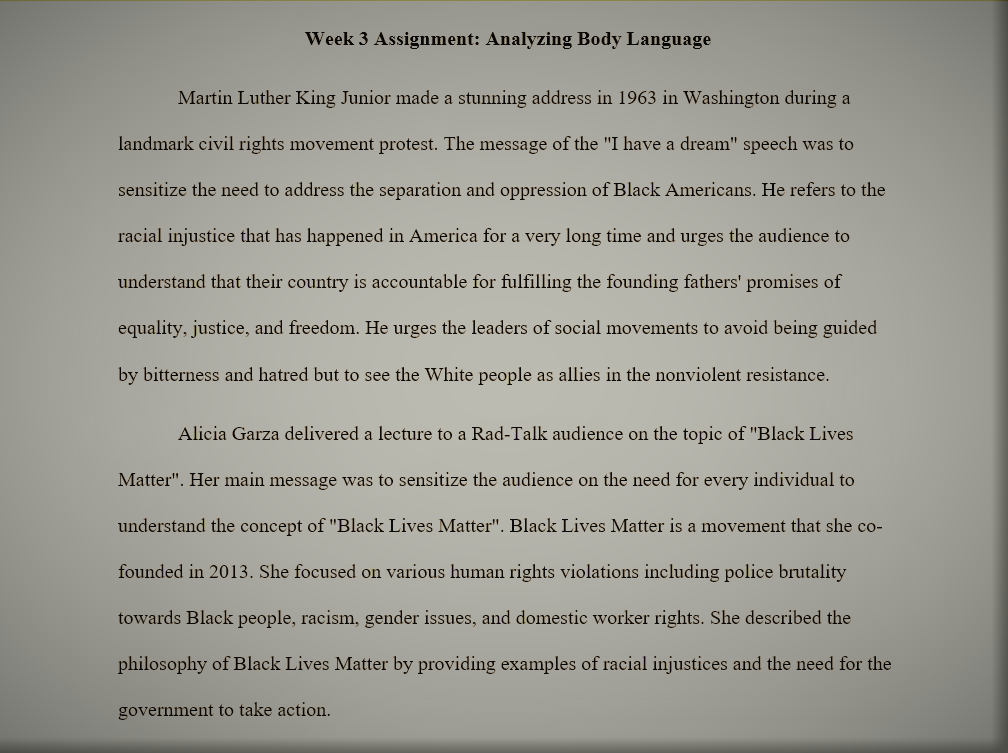
Alicia Garza delivered a lecture to a Rad-Talk audience on the topic of “Black Lives Matter”. Her main message was to sensitize the audience on the need for every individual to understand the concept of “Black Lives Matter”. Black Lives Matter is a movement that she co-founded in 2013. She focused on various human rights violations including police brutality towards Black people, racism, gender issues, and domestic worker rights. She described the philosophy of Black Lives Matter by providing examples of racial injustices and the need for the government to take action.
There are several similarities in the manner in which King and Garza delivered their speeches. They both used hand movements and facial expressions when emphasizing a point. When describing a history of oppression or a negative experience, their facial expression demonstrated sympathy. When describing a positive instance, such as the hope that the battle will bear fruit and lead to change in the future, their facial expressions demonstrated optimism. They also used vocal emphasis, changes in word order, eye contact, and meaningful poses, which are important for engaging the audience as opposed to normal reading (O’Hair et al., 2017).
The main difference between the two speeches is that King’s speech has more fire and intensity and that is why his audience reacted better than Garza’s. His communication was swift leading to a contagious impact on the audience in relating with n the battle for the civil rights of African Americans. The audience became convinced that there was still hope to fight for and achieve equality because of the zeal with which he communicated his message. The accentuated each line of his words using a powerful voice. He declared that all people are equal regardless of color using data and the everyday difficulties that people faced. He prayed that his goal would come true using graceful and vitalized body language (Naser et al., 2020). In contrast, Garza’s address lacked the fervor and power that would have helped convey her message more effectively.
King picked Lincoln Memorial as a venue for a purpose. Abraham Lincoln fought slavery when he was the president. As such, using Lincoln Memorial as a message symbolically meant that King was in support of Lincoln’s efforts to end the discrimination against Black people. Picking the venue sent a message that the proclamation of Lincoln and the constitution should be respected. King also conveyed his message in church to imply that God created all men equally and they should treat each other as such. On the other hand, Garza addressed her audience in a formal gathering of Rad-talks to reach as many people as possible since it was streamed online live as well.
Social networking and other avenues to relay information brought about by technological advancements have changed how the audience perceives the messages. Traditionally, only a few channels of relaying information were available and as such most speakers were only given audience by people who were physically present. Today numerous avenues of relaying messages exist giving people many options to choose from to give audience. The number of people who were physically present at King’s speech was more than those who were present at Garza’s speech. However, given the many avenues of relaying information today, Garza may have had a larger audience since people could stream her lecture online or watch it on television. This could in part explain the little response that she received from the audience.
References
Naser, M. S., Katea, H. H., & Hammadi, M. D. (2020). Martin Luther King Jr’s delivery style in political context: A critical discourse analysis. International Journal of Early Childhood Special Education, 12(2), 77-87. https://doi.org/10.9756/int-jecse/v12i2.201058
O’Hair, D., Stewart, R., & Rubenstein, H. (2017). A speaker’s guidebook: Text and reference. Bedford/St. Martin’s.
To get your original copy of this paper, please Order Now
Related Questions
Our Culture and the News Media (ANSWERED)
Pros & Cons of Interest Groups (ANSWERED)
Democracy and Income Equality (ANSWERED)

