
 USA: +1 508 290 1604
  Sign in

Comprehensive Marketing Plan for 3D Printing
Executive Summary
An opportunity to offer a disruptive product into the market requires the organization to develop a contemporary marketing plan that speaks to the analytical purposes geared towards responding to the desires and expectations of consumers. A good product needs the attention of the customers for them to experience the quality of performance delivered to the product that creates significant value.
The marketing plan will identify the essential features of the market through to describing the different steps that will be formulated towards establishing a framework that will fulfill consumer needs. The change that 3D printing is expected to initiate in the printing sector is supposed to offer an entirely new paradigm when it comes to advertising, naming, and printing of several materials that ensure the printing moves to the next level boosted by innovation. Innovation stands out as a critical undertaking towards establishing a new dispensation where printing creates great satisfaction that will yield tremendous returns on investment to several entities.
Moreover, the marketing strategy will look at the different market elements in the preparation of a plan that enhances the competitiveness of the product in the market. A focus on the distribution model, communication and promotion initiatives to different target markets, a costing and pricing table, ethical concerns and legal together with regulatory aspects relating to innovative business. The marketing plan will ensure that the significant factors that determine the success of the innovative product in the market especially the role of consistent research and development are addressed towards better performance. Innovation is the way to go especially in a society where the consumers have high expectations when it comes to exploring the new ways of doing things.
Introduction
This plan is an academic paper in Marketing Management, succumbed as part of the requirements for the Master of Business Administration (MBA) Degree program at Franklin University (Oman Branch). Precisely, it contracts with a complete plan to Improve the Quality of Marketing Practices for the 3D printing product, which is a new way of printing or a technology of converting digitalized objects into a tangible 3D objects.
In this paper, we deliberate and describe the Potentiality/demand for the product, and the Investment required to produce this product. Furthermore, the paper illuminates how the competitive advantage of the product will be enhanced by improving the Marketing mix identified on the framework. Moreover, the plananalyzes the Customer buying and NPD processes, andrecommends some sort of Distribution strategies that wouldbe utilized to improve the quality of marketing practices for the product. Additionally, the report explains the product’s Costing & pricing strategies. Finally, this plandeliberates the Legal and regulatory aspects related to our innovative business, and describes the ethical issues involved and need to be addressed for the product.
In any business venture, there is a feature that plays a pivotal role in regards to the success or otherwise of the undertaking to achieve the primary purpose of the business venture. Marketing is the standard item that defines the success of the firm as it entails the activities that are geared towards product promotion to influence the sales of the company earning revenue and inspiring exponential growth.
The Segmentation, targeting and positioning (STP) strategy will be the sound basis of the marketing plan since it will enable a sufficient model that acknowledges the diversity of the market to offer a specialized attention to each segment. Segmentation refers to the efforts that ensure the marketing team maps out different regions towards gaining critical information about the characteristics of several market segments (Toften, &Hammervoll, 2013). Understanding what works in a given segment will benefit the entity towards achieving the specific solutions that will resonate with different market populations. Targeting comes in as the second step in the procedure to identify the potential users of the printing product so that the marketing initiates the attention towards such a segment. The target will be the location where the resources and timely disbursement of information about the product will be directed to for substantive gain of the consumer uptake of the innovative product. Positioning is the final stage of the model that will handle the implementation of the strategy with a motivation towards conquering the market marked by intense competition (Schlegelmilch, 2016). Positioning looks at the strengths and weaknesses of the product based on the identified information through segmentation hence deliver the framework for conquering the market armed with the consumer expectations for fulfillment.
The marketing plan is one of the tools that determine the suitability of a marketing strategy as in any business endeavor having a good plan in place provides leverage on the ability to make sound actionable decisions on various aspects (Stasch, 2010). The cardinal principle has always been a narrative suggesting that people will only be planning to fail if they disregard the art of planning. The potential is ambitious and can only be converted into realism through a concerted effort to employ an available marketing plan that will disrupt the market dynamics streaming revenues in through satisfying the consumer needs.
The design and business model of the organization are anchored on innovation that creates significant input to the market but only requires a practical strategy that is based on actual statistics on the ground to take the venture to the next level. A good marketing plan entails some features that can push through to an action plan and deliver the intended benefit of the program to the business. The innovative 3D printing product should gain a significant market niche through a working program that takes cognizance of issues that will define a prosperous framework which will establish the underlying determinants of efficient business performance (3D Printing, 2017).
Potentiality / Demand for Product
The innovative product has developed a new dispensation in the printing sector offering a better version when it comes to advertising and art through the more appealing 3D printing that is expected to change the customer experience. The demand for the product will be overwhelming since the innovation put in place is based on research, and through the tests, there is already a fascination created across several markets in anticipation of the product (Armstrong et al., 2015). The advancement of technology around the world has previously proved the desire held by people towards embracing change established by innovation. The 3D print outs are depicting a new paradigm in printing that will elicit demand with a threat of rising competition making it imperative for a marketing plan that will create a solid market niche. The potential market segments will establish an allegiance to the product after the quality of service experienced through the utility of the printers.
The enthusiasm that comes with the printer being able to convert the digitized objects into tangible 3D objects has been evident especially among the youth. The use of the products in universities and institutions will automatically increase the demand for the printers making it critical to continuously better the product so at to establish a sustainable brand in the market. An estimated projection of an increased demand for 3D printing standing at U.S $ 16.8 billion by 2022 explains the reason behind the requirement to boost marketing initiatives towards retention and increased sales (3D Printing, 2017). The product being innovative requires tackling the market with an underlying understanding of consumer behavior and the possibility of increased stiff competition for the lucrative market.
Investment Requirements
The marketing initiatives should assert more focus towards utilizing technological advancement as a tool to beat the innovative disruption created by the 3D printing. The continuous use of 3D printing across different industries from the automotive, consumer products, aerospace, and medical among other fields increases the demand hence a significant capital endowment required (3D Printing, 2017).
The investment needs enough financial resources that will finance the marketing strategy together with research and development that will keep up the trend towards the transformation of printing. Most business entities rely on the 3D printing for various tasks in their organizations hence the growing demands means increased profitability and returns on investment. The project to introduce an innovative product requires substantial capital investment but equally with a strategic positioning mechanism means the returns make investment sense since they initiate substantive value in the market. The performance of the product in the market is an actual manifestation of the progression that the business yields especially when it comes to providing quality service delivery to the market through the product. The demand provides a positive correlation to the expected benefits to the organization after establishing an articulated strategy that engages the market in having quality products and consumer behavior towards the product.
Marketing mix
Marketing mix framework adopted by the design thinkers team to disseminate information and carry the project process aimed at the target consumer in order to launch the new 3D printing innovative product. Our marketing mix is guided by the underlying internal and external factors that are present in the business environment (Yoo, Donthu, and Lee, 2000). It is designed in a very simple approach to consider all the main elements of marketing our product to meet and satisfy the needs and wants of the consumers. Our marketing mix consists of four main elements which are product, price, place, and promotion.
| Product
The 3D printer innovative product is a new way of printing or a technology of converting digitalized objects into a tangible 3D objects. The printing industry creates a variety of applications that are mainly used in firms dealing with: research, education, entertainment, automotive and aerospace. 3D product’s design is good, high quality color, and durability. Due to its features, the product is more preferred by potential customers since it is price affordability. The brand name of the product is Ultima Ker 2+. There are many services 3D used in: – Prototype models for specific needs made by human hand – Engineers convert their design to tangible model. – 3D improve and crates a good market in many fields such as healthcare, aerospace, industrial segments, automobile, education, government, defense, and entertainment. – Healthcare, use in industrial medication and develop the medical products, especially for dental clinics. Also, it applied in the manufacture of artificial organs for the use of implants such as hip, knee, special joints, hearing aids, orthopedics and prostheses for patients with osteoporosis and cancer. – In aviation sector, 3D printing used to manufacture main applications in the aviation sector, such as wings, air sensors, and air controller. – An approximate of 5000 companies is already in need of 3Ds services. – Stakeholders hope to achieve high return on investments that will help as a supporting activity in their value of chain. |
Price
-Some pricing strategies in 3D printing are: penetration, skimming, cost-based, cost plus pricing, premium and value-based pricing. -3D is estimated at an approximate of $50 billion -By the year 2020, it is expected to escalate to $180 billion. -3D printing market is approximated to garner around $9 billion by the year 2020. -The value of the product and its versatility is reason enough for any consumer to consider buying 3D printer products. -3D printing price affordability. -The Ultima Ker 2+ prices start from $2, 499. -External stakeholders hope to cover the Asian market that approximates to 500,000 consumers annually regarding purchasing materials and also service that will lead them to gain an estimated profit of $2,000, 000
|
| Place
-3D product place where the distribution model will creatively offer value for the customer to disrupt the target market and maintain an expansive market niche. -Supply chain model will provide an accessibility framework to help improve the product’s innovative structure. -The distribution will involve a blend of direct and indirect distribution depending on the nature of market dynamics and landscape. -Global market is a very challenging making it a requirement for the organization to understand the market environment from a legal, economic and cultural perspective. -Asia-pacific region has shown a fast growing market segment for 3D printing.
|
Promotion
There are different elements of Promotion mix; 1. Advertising: – In 3D printer emotional marketing will target the psychological aspect of target consumers. – In order to develop an image, stakeholders shall first target opinion leaders. – For opinion formers, they shall mainly target social media reviews and celebrity reviews. – The main forms of media that will allow a comprehensive presentation of the 3D image are: social media, television, digital billboards, and posters. 2. Personal Selling – Focused on developing personal contact with the customers and the retailers. – To expand the sales, we shall develop a good relationship with the retailers. 3. Sales Promotion – To develop a continuous flow of the message, we shall use viral videos and podcasts. – Select a podcast celebrity as the main brand ambassador for the product. – Develop such podcasts allowing other customers to participate. 4. Public Relations – Corporate social responsibility (CSR) is a technique help any company to create and maintain a good reputation in society. 5. Direct marketing – Target the customers using many tools such as online advertisement, podcasts and email addresses for only those who subscribe to email services.
|
Customer Buying Process
Buying/ Purchasing decisions, utilizing and dispose a product are all depending on the consumer behaviors. A purchaser will not purchase any product at random, but he/she would utilize the actual buying process that consists of several steps (Solomon, 2014). A 3D printer is a non-impulse product due to its high value and individuals intending to purchase it are more likely to take on a set process. The five steps of the buying process are as follows:
- Identifying/ Recognizing the Needs: The first step in the buying process is recognizing the need or problem. The need could be to replace a 3D printer that is no longer working.
- Information Search: In this step, the purchasers will seek for comprehensive information on the product from a variety of sources that include internet, friends or even family members. Relevant information such as brands, price and where to buy the product is readily available on the online platforms. The consumers will get the specifications he or she needs to make the decision.
- Evaluating the Alternatives: This step is to evaluate the purchase alternatives that are on hand. The features which appeal to the purchaser as well as product perception differs depending on the individual’s taste. while a consumer will be interested more in the brand than price, another will value appearance. When buying the 3D printer, the customers may be considering the effectiveness and printing speed. In this case, the marketer will emphasize additional information to the purchaser about the sole, unique, and distinctive features of the 3D printer.
- Purchase Decision: The other step is selecting the product which the customer would like to purchase. At this point, marketers have to make sure that the process of buying is simple, satisfying as well as valuable to avoid the buyer from changing his/her mind to revoke the purchase or chose a product from a competitor (Ferrell & Hartline,2012).
- Post Purchase Behavior: finally, the consumer can portray post-purchase behavior. The marketer should reassure the buyer about the quality of the product to create a high image of the organization.
NPD Process
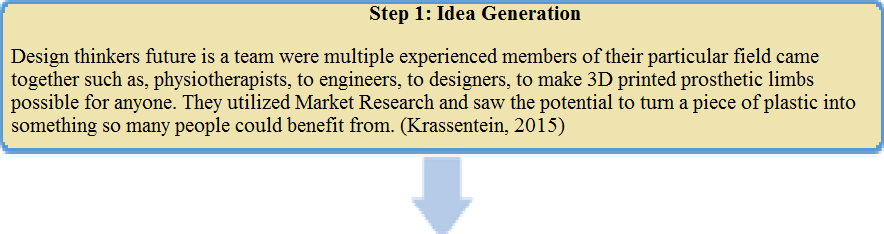
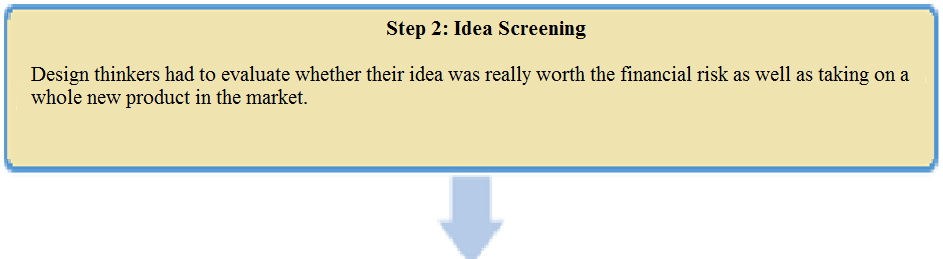
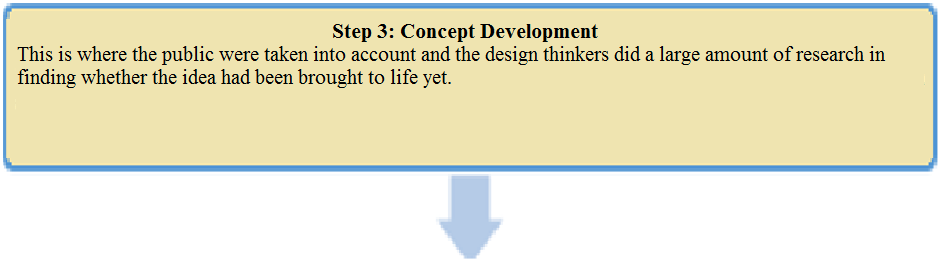
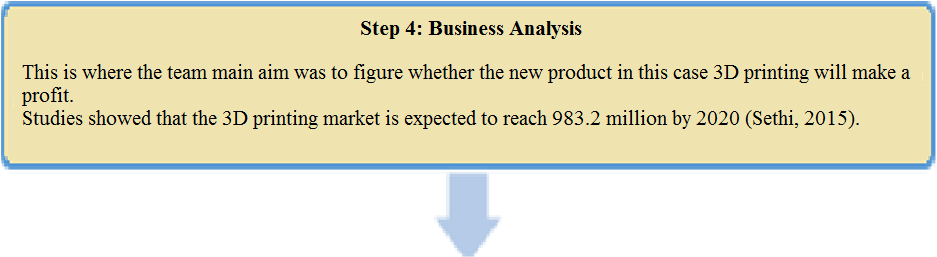
The design thinkers team had to go through and execute the New Product Development process in order to remain success to obtain the new 3D printing product. Although there are some problems that will face us, but it’s going to be a challenge for us to achieve our goal. The different stages of the NPD process are as follows:
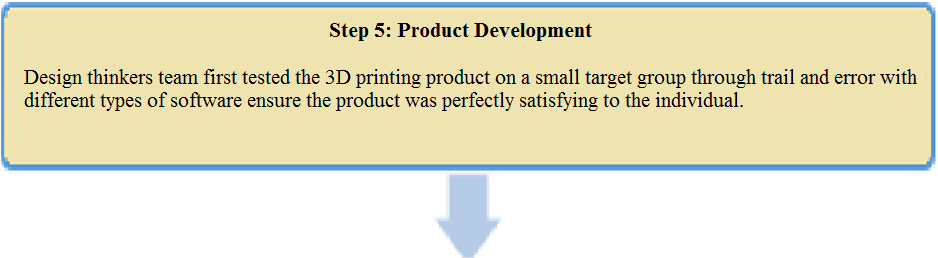
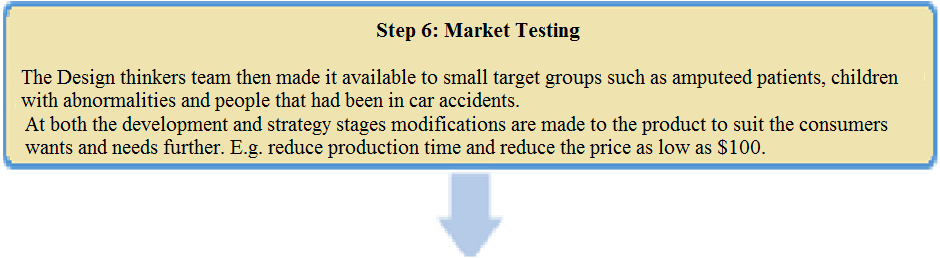

Distribution Strategy
The place where the people will have an opportunity to access the services from the product will be through a dedicated e-commerce platform backed up by a dedicated distribution strategy (Schlegelmilch, 2016). The website will reach a significant number of customers despite the geographical location hence it will impact the product positively through fostering convenience. Timely communication will provide the best solution for innovation in having a platform where people can remotely request for the product, and it becomes delivered at the position they prescribe (Kim, &Sohn, 2016). The distribution will involve the establishment of an elaborate supply chain model that partners with competent logistics companies and retail outlets to offer timely deliveries to consumers on demand.
The distribution and global marketing methodology of the new product require the initiation of marketing strategies that will deliver a structure where that resonates with the potential customers. The ultimate goal of our marketing strategy is to inform the consumers of the value that we bring in the development of the product. The 3D printer is designed in a manner that creates an innovative product capable of ensuring the customer printing needs are responded to in a fashion that assures high quality thereby providing excellent customer experience (Armstrong et al., 2015). The product will come with additional customer service that assures of delivery of an experience where the product brings value to the consumers.
The entry into the global market requires the initiation of a marketing strategy that has mastered the art of developing a disruptive effect on the market especially when it comes to the chain distribution channel that limits stock out costs to the entity. An elaborate market plan will take into consideration the development of a segmented strategy where the distribution structure will be able to respond to the market demands for the product (Kirner, Som, &Jäger, 2015). The supply chain model will provide an accessibility framework where they will equally act as a point where customer feedback will be collected to help improve the innovative structure of the product.
The global market is expansive and requires that we understand the best way to manage an efficient supply chain model that assures the inclusion of the marketing mix of a pricing, product promotion, and place strategy. The distribution will involve a blend of direct and indirect distribution depending on the nature of market dynamics and landscape. The forward chain model of the supply chain will ensure a substantive market coverage where the innovative initiative will reap a significant market niche. The intermediaries will be introduced in the chain to help expand the distribution network and reduce the costs of supply but will be carefully monitored to avoid the threat of sabotage that might cause artificial shortages. The logistics are structured in a manner that they will deliver both an intensive and selective distribution structure that will ensure all the potential customers are served with the 3 D printers in real time (Schlegelmilch, 2016). The best form of training will continuously be administered to the distribution staff together with employees in the desire to equip them with relevant skills that combat the ever changing nature business in the modern world.
Costing and Pricing Strategy
Price is a critical feature that will ensure a successful take-up of the product of the consumers through ensuring that people get the best quality at an affordable rate. The intention of the product was to provide an innovative disruption in printing that will create value for the consumers through ensuring the printing experience is above board. The price strategy will take the model of a price penetration mechanism where the organization will initiate a small price when the product is launched into the market to inform consumers and let them experience the benefits of the product. After the product has established some form of relevance in the market since it is a new product desired by many the price will slightly increase to sustainable levels for both the company and the consumers. The ability of the organization to perform excellently well will establish the product among the consumers through an objective pricing framework that ensures the company makes the profit as well as avoid compromising on quality. The perceived value of the product will be ascertained after the introduction of the product at a slightly low price compared to the competitors offering different products in the market. Economies of scale will be an analytical instrument that will ensure the achievement of the operations providing an unbeatable 3D printing product (Patino, Pitta, & Quinones, 2012).
Legal and Regulatory Aspects and Ethical Issues
The market elements of introducing the product will be implemented through conducting market survey and interviews to determine whether the people are ready for the development. The respondents will make the company ascertain whether the target market for the product is viable to warrant the investment (Turner, 1991). The surveys will also ensure the suggestions made by customers are valued, and efforts are made to incorporate them into the product. The expected challenge that the product might face is government regulations, and the possibility of the competition after competitors introduce a similar model in the market. However, the organization will take on innovation and quality customer service to edge out competitors that might desire to take on their established market niche. The strict incorporation of strong ethical standards in the organization together with an absolute observance of the underlying legal provisions around the different market segments to prevent litigation related losses.
The revenues collected will be measured against set targets that were intended to have the expenses covered without any difficulties. The potential challenge will be the painting of a perception that the low prices are indicative of the value they should expect and equally having a high price can scare away potential clients for the product. However, the organization will ensure that the pricing is not very low to adversely define the type of product but rather go slightly down the objective price to attract consumers for a satisfying experience that awaits them. The success of the model will significantly depend on the quality of service offered in agreement with the description during marketing the product (Grabovskiy, &Kostyuk, 2014).
Conclusion
In conclusion, the organization will ensure that adverse effects that will potentially interfere with the quality of service rendered to customers are eliminated through devising of a plan that will see the cost of operations go down. The application of technology in the functioning of the organization will boost the efficiency and ability of the product to provide a remarkable experience to the consumers. Technology will reduce the costs and enable the organization to take advantage of the number of customers that order the product since a collective batch makes the price cheaper and economical for the entity. The strategies that are geared towards reducing the cost will provide an opportunity for the organization to charge customers at a cost that is affordable as they will pay less for much more. An effective market plan will initiate great progression of the product into the competitive, innovative 3D printing sector of the printing business.
References
- 3D Printing. (2017, April). Retrieved from http://www.strategyr.com/Marketresearch/3D_Printing_Market_Trends.asp
- Armstrong, G., Kotler, P., Harker, M., & Brennan, R. (2015). Marketing: an introduction. Pearson Education.
- Boone, L. E., & Kurtz, D. L. (2013). Contemporary marketing. Cengage learning
- Grabovskiy, E., &Kostyuk, Y. (2014). Analysis of the specificity of improving the efficiency of marketing activities of the enterprises of power. 153-155.)
- Kim, H., &Sohn, S. H. (2016). Impact of Advertising Model’s Body Size on Perceived Product Quality: Category-Based Induction Approach. Journal of Promotion Management,22(1), 151-174. doi:10.1080/10496491.2015.1088924
- Low, G. S., & Mohr, J. J. (2000). Advertising vs sales promotion: a brand management perspective. Journal of Product & Brand Management, 9(6), 389-414. doi:10.1108/10610420010356984
- Moensted, M. (2006). Networking for innovation. High-tech Entrepreneurship: Managing Innovation, Variety and Uncertainty.
- Patino, A., Pitta, D. A., & Quinones, R. (2012). Social media’s emerging importance in market research. Journal of Consumer Marketing, 29(3), 233-237. doi:10.1108/07363761211221800
- Schlegelmilch, B. B. (2016). Global Supply Chains and Distribution Networks. In Global Marketing Strategy(pp. 129-151). Springer International Publishing.
- Stasch, S. F. (2010). Creating a successful marketing strategy for your small new business. Santa Barbara, CA: Praeger/ABC-CLIO.
- Toften, K., &Hammervoll, T. (2013). Niche marketing research: status and challenges.Marketing Intelligence & Planning,
- Turner, P. (1991). Using Information to Enhance Competitive Advantage – The Marketing Options. European Journal of Marketing, 25(6), 55-64. doi:10.1108/03090569110000664
- Yoo, B., Donthu, N. and Lee, S., 2000. An examination of selected marketing mix elements and brand equity.Journal of the academy of marketing science, 28(2), pp.195-211.
Appendices
Appendix A: 3D Printing Ad Sketch
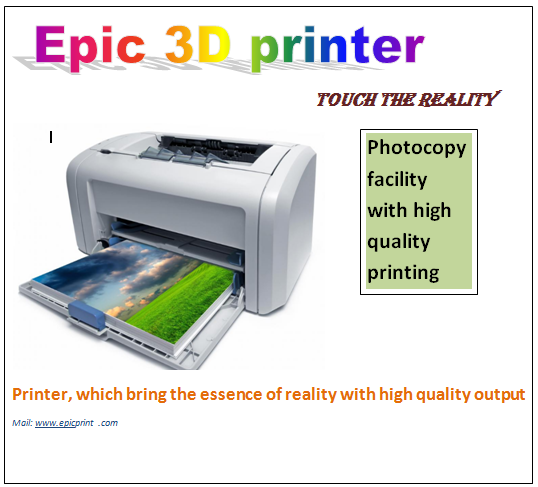
In order to create the brand identity among the competitive arena proper selection and use of channel is determined the fruitfulness of that proposed product. Appropriate communication process by using different tools and techniques is helping any organization to improve their promotional activities and enhance the brand value.
Appendix B: Comprehensive Marketing Plan 3D Printing Rubric – Total 150 points
| Criteria | Unacceptable | Acceptable | Proficient | Student Score and Comments | |
| Identifies the way(s) in which the success of key elements of the marketing plan will be measured. | Vaguely identifies the way(s) in which the success of key elements of the marketing plan will be measured or is completely off topic.
(0-15 points) |
Identifies the way(s) in which the success of key elements of the marketing plan will be measured and, for the most part, fulfills assignment requirements.
(16-17 points) |
Identifies the way(s) in which the success of key elements of the marketing plan will be measured and demonstrates solid ability to accomplish the assignment.
(18-20 points) |
||
| Writes an Executive Summary. | Poorly writes an Executive Summary.
(0-6 points) |
Writes an Executive Summary and, for the most part, fulfills assignment requirements.
(7-8 points) |
Writes an Executive Summary and demonstrates solid ability to accomplish the assignment.
(9-10 points) |
||
| Integrates established marketing principles and terminology into the discussion.
|
Rarely integrates established marketing principles and terminology into the discussion.
(0-49 points) |
For the most part, does a good job of integrating established marketing principles and terminology into the discussion.
(50-59 points) |
Consistently does a good job of integrating established marketing principles and terminology into the discussion.
(60-70 points) |
||
| Synthesizes information with critical thought and develops ideas with clarity and logic. | · Synthesizes information at a minimal level.
· Demonstrates little clarity and logic. Readers have difficulty following the line of reasoning.
(0-17 points) |
· For the most part, effectively synthesizes information, which supports main ideas.
· Develops ideas with clarity and logic. Readers can generally follow the line of reasoning.
(18-21 points) |
· Consistently and effectively synthesizes information, which provides strong support to main ideas.
· Develops ideas with clarity and logic. Ideas flow smoothly from one to another and are clearly linked to each other.
(22-25 points) |
||
| Uses credible documentation that has been properly referenced and cited.
|
Inadequate or minimal use of credible documentation or not properly referenced or cited.
(0-17 points) |
For the most part, uses credible documentation that is properly referenced and cited.
(18-21 points) |
Consistently uses credible documentation that is properly referenced and cited.
(22-25 points) |
||
|
SubTotal Points |
|||||
| A mock-up of your innovative product | Did not submit.
Minus 30 points |
—– | —- | ||
| Turnitin.com | Did not turn paper into Turnitin.com.
Minus 10 points |
—- |
—- |
||
| Revisions based on the Originality Report | Did not revise paper based on the Originality Report.
Minus 10 points |
—- |
—- |
||
| Graduate level writing
|
Did not demonstrate an adequate ability to write at the graduate level.
Minus 0-30 points |
—- |
—- |
||
| Total Points = | |||||

