
 USA: +1 508 290 1604
  Sign in

US Dollar Currency Report
Introduction
Use of currency for transactional purposes is deemed to be a mundane part of the day to day operations and the driver to the economic system. Basically, the fundamental role of a currency is derived from the common role they perform in daily transactions to the subtle role of a monetary and financial system. The main purpose of this paper is to look at the US currency and give an insight into the US exchange regime, monetary policy, the strengths and weaknesses of the US dollar, and also pin down the future of the US currency.
Exchange Regime
The Bretton Woods Agreement signed in the year 1944 was intended to set an exchange system that would guide the international market. The United States signed the agreement indicating that it would exchange US dollars at a base rate of $35 per gold ounce. Other signatory nation’s currencies were tied down to the U.S dollar and a deviation limit was set to 1%. From this pegged value, central banks would sell or buy US dollars to their currency remained within permitted fluctuation band (Burange & Ranadive, 2011). As Burange and Ranadive indicate, central banks normally bought and sold U.S. dollars to ensure that their currencies remained within permitted fluctuation band. It’s through the Bretton Woods Agreement that the US dollar became the official world’s reserve currency.
The exchange regime established through the Bretton Woods Agreement proved to be unstable as the gold value shifted and the gold reserves became insufficient in the year 1971 (Burange & Ranadive, 2011). Therefore, the terms of the agreement were broken and the fixed exchange rates broken. In 1973, a floating exchange regime was adopted and runs the US currency system to the present. Importantly, the fixed exchange regime placed the US as an important international transaction currency. The US dollar has since then endured the international market as a global market leader. For example, in the year 2007, 86 per cent of the foreign exchange transactions conducted were based on the US dollar. Currently, the US dollar accounts for 63 per cent of the world reserves. Basically, the US dollar still remains to be the reserve currency even when it’s not backed by gold.
Presently, the dollar has had some experiences of strengths and weaknesses. There have been moments where the US dollar in the post-Bretton Woods era where the currency has gained great strength. For example, from 1981-1985, the US corresponded with a loose fiscal policy and a tight monetary policy adopted during the Reagan administration (Ekaterina, 2014). The second instance was during the 1997 to 2001 period which coincidentally happened during the technology bubble. According to the Federal Reserve dollar index, in 2009, the US rose again by a 7% above its all-time low. Recently, the US dollar has been on the decline. In the year 2017, the dollar value fell by about 10 per cent marking a great annual decline since the year 2003 when the dollar faced a 15 per cent annual decline. The main contributor to this decline was the continued euro’s strength. Further, the central bank raised rates and continued strong economic performances by other countries led to the dollar being deemed less attractive.
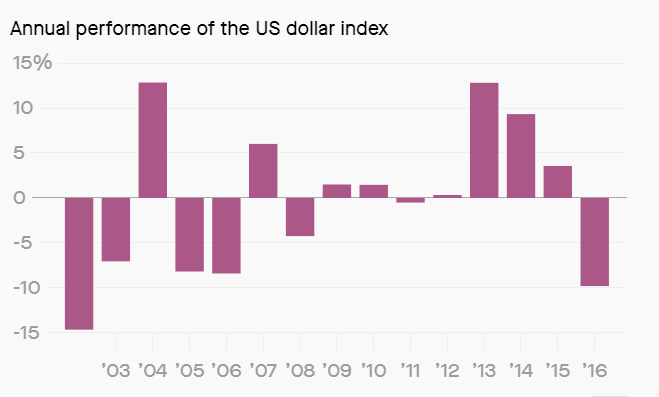
In the year 2018, the factors that have been contributing to the decline of the US dollar have taken a reverse path. Since the start of 2018, the Treasury yield has risen by 3% by March compared to 2017. In this year, the Federal Reserve System has ensured that the inflation rate is maintained within the 2% target (Wee, 2018). Understandably, the US dollar growth outlook presents a favorable moment for the US dollar to remain strong in the international market. A close outlook is provided in Figure 2 below.
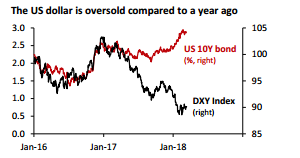
Figure 2: US Dollar Performance in the Market
Monetary Policy
The US monetary policy was designed in such a way that it affects all spheres of financial and economic decisions made by Americans. For example, the monetary governs actions such as purchasing a new car, house, setting up new companies, getting a loan, or even expanding a business (Federal Reserve Bank, 2004). Further, owing to the fact that the United States has the largest economy, its monetary policy significantly affects the economic and financial actions of many countries across different continents. The US monetary policy is guided by the Federal Reserve System and influences how short-term interest rates are raised or lowered.
Since the 1977 amendment, the Federal Reserve has focused on performing its two main goals; promoting stable prices, and promoting maximum employment and sustainable output. Purposely, the monetary policy is intended to ensure that consistent levels of savings, employment, and other work efforts remain over the long run (Federal Reserve Bank, 2004). The US monetary policy has also been on the lookout to ensure that inflation remains at acceptable levels. Similarly, US monetary policy uses tools to regulate and influence the output, employment, and inflation in an indirect manner. Particularly, it does this through the federal funds market which is an open market operation for bank reserves.
Strength and Weaknesses of US Currency on World Market
A major reason why the US dollar remains a global market leader in the international reserves is that the US dollar has garnered several advantages over other currencies. Understandably, nearly every commodity is settled in U.S dollars in the international trades. Many of the transactions being conducted internationally are invoiced and settled in U.S dollars even in events where the US is not the destination or the source of goods and services being transacted. Second, the United States has the largest, most transparent and most liquid financial markets across the globe (Kishan, 2018). Third, different countries rely on the US as the final destination for their exports. As such, these markets manage their exchange rates against the US dollar to ensure their domestic costs remain low. Such actions lead to higher accumulation of large dollar reserves. Further, many countries rely on the US for military support and protection. Additionally, a higher proportion of external liabilities for many countries are based on the US dollar. Therefore, they hold their reserves as US dollars which forms an asset-liability against the US dollar. These among other factors have contributed to the great positioning of the US dollar in the international market.
Future Market Expectations
The US financial markets are dominated by transparency which has fostered great stability and a predictable monetary policy for the US. Importantly, this serves as a reinforcement to the safe-haven created by the US dollar legacy. As previously outlined, the US dollar recently accounted for 63 per cent of the global reserves followed by euro which only accounts for 20 per cent of the global reserves (Kishan, 2018). None of the remaining currencies in the global market can account for a per centage higher than 5 per cent. The Japanese Yen takes the third rank accounting for 5 per cent. Understandably, this is a great margin from the euro.
However, that might not be the case forever. Considering that in 2009, the US dollar accounted for 83 per cent in global reserve and that currently, it accounts for 63 per cent. That translates into a 20 per cent decline over a period of nine years. Therefore, projections in the future might hold that the US currency might decline with another 20 per cent by the year 2030. Different countries are striving to gain more economic stability and so are their currencies. Just as the Japanese Yen overtook the Great Britain Pound, the same case might happen to the US dollar. However, the US dollar is safe for now.
Conclusion
Today, the US dollar stands as the global currency that is seconded by the euro in popularity and prevalence. Importantly, it plays a vital role in international trade as it’s considered a mainstream currency that governs most of the transactions in the international exchange. History also indicates that the US dollar has served as the global reserve since 1945. However, the US dollar has faced depreciations and appreciations which indicates that the currency is being swayed by the global financial system (Ekaterina, 2014). However, the US dollar has stood the test of time, while depreciation has been experienced in the system, the US Federal Reserve System works to ensure that the US dollar still holds a strong position in the international market.
References
Burange, L. G., & Ranadive, R. R. (2011). The Evolution of the Exchange Rate Regimes: A Review. Working Paper, 1-50.
Ekaterina, G. (2014). The Influence of the American Dollar on International Trade. Master’s Thesis, 1-46.
Federal Reserve Bank. (2004). U.S Monetary Policy: An Introduction. Federal Reserve Bank of San Francisco , 1-24.
Kishan, H. (2018, August 13). US dollar on its way out as world’s lead currency? Retrieved from DW.com: https://www.dw.com/en/us-dollar-on-its-way-out-as-worlds-lead-currency/a-45111800
Wee, P. (2018). FX outlook 2018-19: The US Dollar is Fed. DBS Group Research, 1-19.

