
 USA: +1 508 290 1604
  Sign in

QUESTION
https://www.youtube.com/watch?
Prior to beginning work on this assignment read “Bees Prefer Foods Containing Neonicotinoid Pesticides” and watch the io – Quick Start Video (Links to an external site.) on how to develop a flow diagram using the free online program Draw.io (Links to an external site.). This program is widely used by corporations including Apple, Canon, IBM, Deutsche Bank, HP, Siemens, and others. Then, view the flow diagram homework example. Downloads are not required to complete the flow diagram, but you will need to save your diagram and upload it to Waypoint as either a Word document or .pdf file.
Select one toxin that you investigated in your Week 1 assignment. Draw a flow diagram on a piece of paper to help you conceptualize how this toxin moves through the environment, including movement through air, rivers, oceans, food webs, soil, and humans.
Visit the draw.io (Links to an external site.) website and use your hand drawing to create a flow diagram that maps the transport and fate of the toxin you selected. Then address the points below.
Explain the flow diagram, highlighting the important points from your diagram and areas of scientific uncertainty.
Explain how a researcher can use the diagram to support the development of a risk assessment.
The Toxicant Flow Diagram
Must include a separate title page with the following:
Title of paper
Student’s name
Course name and number
Instructor’s name
Date submitted
Must document all sources in APA style
Must include four scholarly or credible sources.
ANSWER
Toxicant Flow Diagram
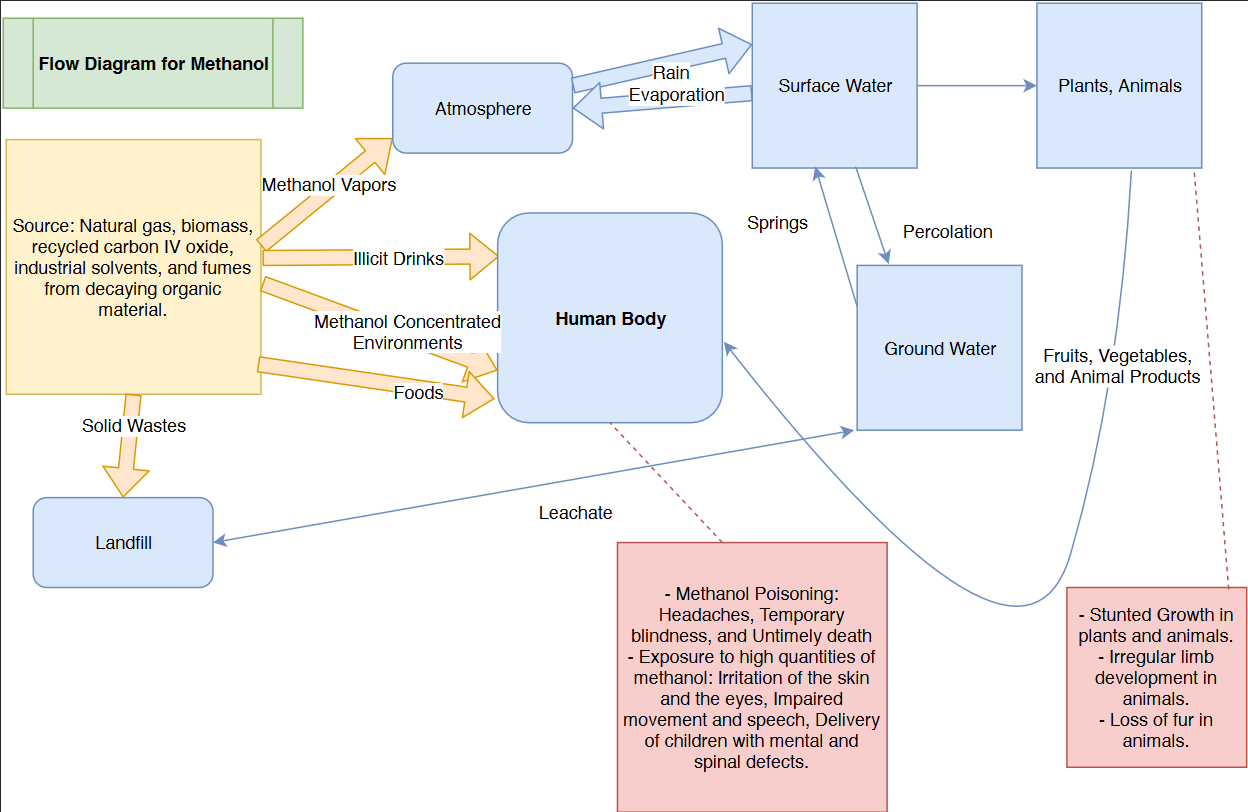
Explanation of the Toxicant Flow Diagram
The toxicant flow diagram attached shows how the toxin, Methanol, moves through the environment – movement through the air, oceans, rivers, the soil, and ultimately to human beings. Methanol occurs naturally in most foods, especially those derived from plants and animals. Moreover, over the last decade, the rate of emission of methanol into the environment has increased greatly, mostly from increased manufacturing activity and fuel production (Blumberg, Tsatsaronis, & Morosuk, 2019). Methanol, when in small quantities in the human body, is healthy. However, huge quantities of methanol become toxic in the human body. Anaerobic metabolism, the decay of organic materials, natural gas, biomass, industrial solvents, and recycled carbon IV oxide are all sources of methanol. Methanol that exists as natural gas and that is released as natural fumes from decaying organic material is released into the atmosphere, where it accumulates and falls to the ground surface as a constituent of rain.
Upon reaching the ground, methanol is collected in surface water that flows through rivers and other water bodies. This water, containing methanol, becomes part of groundwater through percolation. Plants and animals use the water on the surface and in the ground for drinking and for the process of manufacturing food. When human beings use anima and plant products as sources of food, they ingest methanol into their bodies. Methanol is also present in illicit drinks that are not properly brewed to control its quantities. It ends up in the bodies of the people that drink these drinks. Methanol that is present in industrial solvents ends up in landfill after disposal. The leachate from the landfill gets to groundwater, which can then become surface water in the form of water springs on the ground. Surface water ends up in the human body when used for drinking.
Methanol may also reach the human body in the form of vapors when an individual is working in an environment that has a high concentration of methanol. Employees working in industries that use industrial solvents and chemicals that produce methanol are exposed to high concentrations of the gas. Such employees will experience eye and skin irritation. Continued exposure to high concentrations of methanol results in impaired speech and impaired body movement. Methanol that ends up in the bodies of animals and humans can be harmful and even lethal if it is ingested in huge quantities. In human beings, the symptoms of methanol poisoning show after one consumes huge volumes of vegetables, fruits, and aspartame-sweetened drinks and sodas, all which contain methanol.
People who have consumed huge quantities of methanol experience persistent headaches. Methanol poisoning from the consumption of illicit drinks results in headaches, temporary blindness, and eventually, death (Moon, 2017). When consumed in small quantities, such as those found in fruits and vegetables, methanol is safe for human beings and animals. Small quantities of methanol in the human body are metabolized into other products and excreted. When consumed in huge quantities, such as those found in illicit brews, methanol can be lethal to human beings (Oh, Lee, & Min, 2013). Huge quantities of methanol are not metabolized in the human body. They become toxic and cause harm to the skin, the brain, and the eyes.
In addition to experiencing eye and skin irritation, employees working in industries that have environments with high methanol concentration may suffer from long-term exposure to the toxin. These people may experience central nervous system damage, extreme skin irritation, and impaired vision. For the female employees working in high methanol environments, the effects of long-term exposure to the toxin may be manifested in the delivery of children with spinal and mental defects. Methanol affects the development of human fetuses, affecting brain development and resulting in a weak nervous system (Kang et al., 2018).
Methanol that ends up in plants and animals is also harmful and toxic when in large quantities. When plants grow on soil with a high content of methanol, the plants suffer from stunted growth. However, if plants grow on soil that has a controlled or small level of methanol, they benefit in terms of larger stems and leaves. In animals, exposure to methanol for a long period of time results in stagnated growth. Loss of body hair or fur, irregular limb development in young ones, and death.
Risk Assessment Support
A toxicant flow diagram can be used in support of the development of a risk assessment. A risk assessment is used in the characterization of the magnitude and nature of health risks to humans and ecological receptors from contaminants and toxicants present in the environment (Suter II, 2016). Risk assessment may be done in two areas: ecological and human health. By constructing a toxicant flow diagram, a scientist can easily identify the different paths by which a toxicant (or a chemical pollutant) flows through the environment and the effect that it has on human beings and ecological receptors (animals, fish, and plants). By using the methanol flow diagram, a scientist or environmentalist can easily identify the ways through which the chemical reaches human beings and other ecological receptors, as well as the effects that it has on them. From there, the measurements for the extent of contamination and the frequency of contamination can be taken. Action can thereafter be taken to control the release of the chemical into the environment.
References
Blumberg, T., Tsatsaronis, G., & Morosuk, T. (2019). On the economics of methanol production from natural gas. Fuel, 256, 115824.
Kang, C., Kim, H., Shin, K., Ryu, J., Jung-Choi, K., Lim, K., & Kim, J. H. (2018). Toxic effects of methanol among illegally dispatched workers at aluminum CNC cutting process in small-scale, third-tier subcontractor factories of smartphone manufacturers in the Republic of Korea. International journal of environmental research and public health, 15(7), 1332.
Moon, C. S. (2017). Estimations of the lethal and exposure doses for representative methanol symptoms in humans. Annals of Occupational and Environmental Medicine, 29(1), 44.
Oh, C., Lee, Y., & Min, S. (2013). Estimation of Methanol Exposure Level via Alcoholic Beverage Consumed by Jecheon Citizen, South Korea. The Korean Journal of Food and Nutrition, 26(1), 44-50.
Suter II, G. W. (2016). Ecological risk assessment. CRC press.

