
 USA: +1 508 290 1604
  Sign in

QUESTION
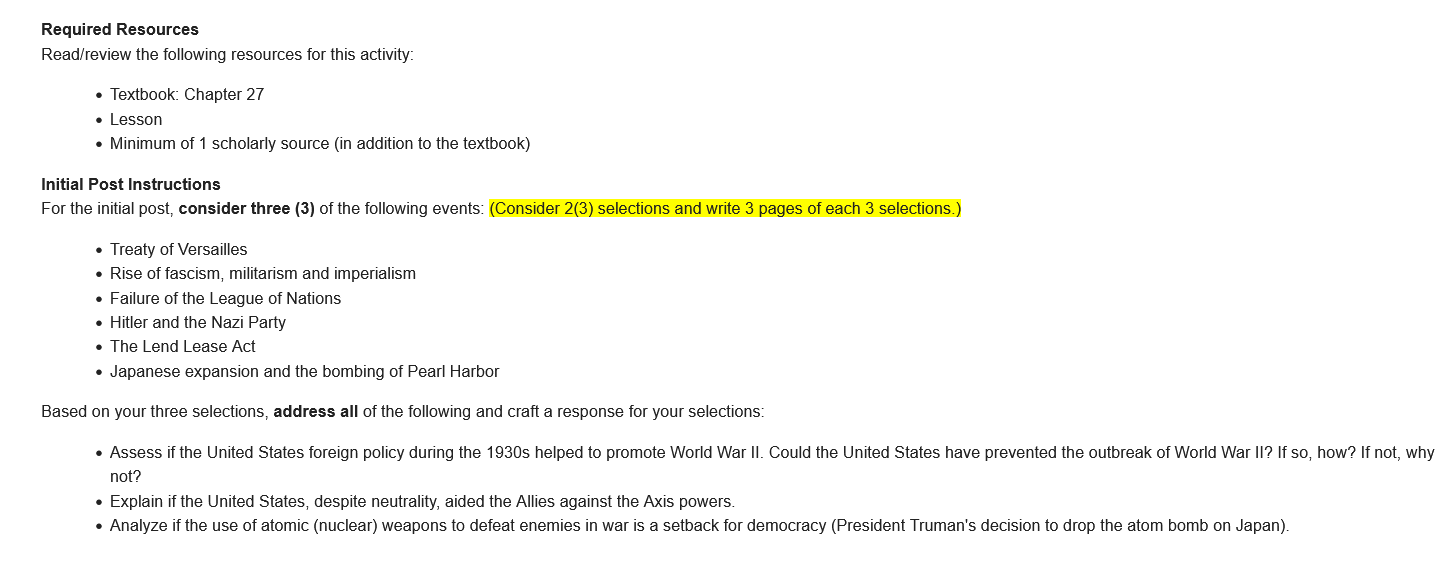
Required Resources
Read/review the following resources for this activity:
- Textbook: Chapter 27
- Lesson
- Minimum of 1 scholarly source (in addition to the textbook)
Initial Post Instructions
For the initial post, consider three (3) of the following events: (Consider 2(3) selections and write 3 pages of each 3 selections.)
- Treaty of Versailles
- Rise of fascism, militarism and imperialism
- Failure of the League of Nations
- Hitler and the Nazi Party
- The Lend Lease Act
- Japanese expansion and the bombing of Pearl Harbor
Based on your three selections, address all of the following and craft a response for your selections:
- Assess if the United States foreign policy during the 1930s helped to promote World War II. Could the United States have prevented the outbreak of World War II? If so, how? If not, why not?
- Explain if the United States, despite neutrality, aided the Allies against the Axis powers.
- Analyze if the use of atomic (nuclear) weapons to defeat enemies in war is a setback for democracy (President Truman’s decision to drop the atom bomb on Japan).
ANSWER
Option 1. Failure of the League of Nations/The Lend Lease Act/ Rise of fascism, militarism and imperialism
Assess if the United States’ foreign policy during the 1930s helped promote World War II.
The United States pursued an isolationist policy regarding other countries’ internal affairs. Political leaders determined it was best to avoid alliances that did not support their interests. They felt Americans should stay neutral and avoid any commitments restricting their independent action, motivating them not to join the League of Nations (Doenecke, 1982). One of the ultimate causes of WWII was the League of Nations (LON) failure. LON was a peace-keeping organization created to promote peace and maintain territorial integrity by reducing power struggles (Goodrich, 1947).
Corbett et al. (2016) indicate that America’s failure to join the League of Nations rendered the organization insignificant and shattered its international authority (p.627). The League did not have an armed force and relied on member nations to enforce its decisions. It could not support economic sanctions or military support when needed, explaining why it could not stop the aggression of the Axis Powers. As Corbett et al. (2016) indicate, US’ absence in the League weakened its power and authority to control the expansionism, militarism, and fascism that caused WWII. Therefore, it is logical to assume that the US promoted WW2 by weakening the organization responsible for maintaining world peace and territorial integrity.
Could the United States have prevented the outbreak of World War II? If so, how? If not, why not?
The US could have prevented WW2 if it had committed member countries to action in case of treaty violations. Corbett et al. (2016) reveal that the US tried to stop the war despite having an isolationist policy. Between 1921 and 1922, the US reduced the army size of nine signatory nations (Corbett et al., 2016, p.724). It also signed the Four-Power Treaty, which committed the signatory countries (US, Britain, Japan, and France) to avoid territorial expansion in Asia. The US also signed the Kellogg-Briand Pact alongside 14 other countries (Corbett et al., 2016, p.724). This pact stipulated that declaring war on another country was an international crime. Unfortunately, none of the treaties committed the signatory countries to act when another nation violated the treaty. If the US ensured each signatory country pledged commitment to the treaty, it is highly likely ww2 would have been prevented. Also, if the US had joined the League of Nations, it would strengthen the organization, enabling it to fight expansionism.
Explain if the United States, despite neutrality, aided the Allies against the Axis powers.
The US, despite neutrality, helped the Allies against the Axis powers. Congress passed the Neutrality Act of 1935 and the Neutrality Act of 1937 to prevent the country’s involvement in the war. These legislations prohibited the sale of armaments and loaning money to warring nations. Despite these laws being in effect, the US transported 100 p-40 fighter planes to China (Corbett et al., 2016, p.728). Roosevelt also allowed American volunteers to fly these planes. This action helped China prevail against Japan, one of the members of the Axis Powers.
In 1941, Congress passed another legislation, the Lend-Lease. This legislation allowed the US to sell, lease, or transfer armaments to any country it deemed essential to its defense. The Lend-Lease was the last legislation Congress passed before ending its neutrality. Lend-Lease allowed the US to provide Britain, China, the Soviet Union, etc., with war weaponry and supplies. These goods helped the Allies against the Axis Powers.
Analyze if using atomic (nuclear) weapons to defeat enemies in war is a setback for democracy (President Truman’s decision to drop the atom bomb on Japan.
Truman’s decision to use the atomic bomb on Japan was a setback for democracy. Corbett et al. (2016) imply that the first nuclear bomb was justified, considering the number of American lives on the line. According to Corbett et al. (2016), invading Japan’s home island would result in the death of approximately 250,000 Americans. Therefore, Truman’s decision to use the first bomb was justified. Also, the authors suggest that Truman and the scientists working on the project may have been unaware of the bomb’s capability.
Truman’s decision to drop the second bomb is questionable. Corbett et al. (2016) indicate that Truman could have given Japan ample time to respond to the Hiroshima bombing, but he did not. Japan was on the brink of defeat when the US invaded its home islands. The authors also suggest that Truman dropped the second bomb to send a message to Stalin, who had become intransigent in post-war Europe. Corbett et al. (2016) report that if Truman’s decisions were politically-motivated, the US would have become part of the belligerent nations that committed massive atrocities against civilians (p.748). These atrocities are a setback to democracy.
Option 2. Hitler and the Nazi Party/ Treaty of Versailles /Japanese expansion and the bombing of Pearl Harbor
Assess if the United States foreign policy during the 1930s helped promote World War II.
The United States adopted a non-interventionist foreign policy during the 1930s. This policy prevented America’s interaction or involvement in other countries’ affairs, specifically war. This isolationist policy contributed to the war by allowing totalitarianism and authoritarian rule abroad. Corbett et al. (2016) report that America’s absence in the League of Nations weakened the organization’s authority to fight against expansionism or territorial conflicts. In 1931, the League protested Japan’s seizure of Chinese territory but did nothing else to ameliorate the situation. The Japanese bombing of Pearl Harbor was also part of Japanese expansionism strategies. Arguably, Japan expansionism continued due to the lack of accountability. With US’s support, the League of Nations would have had the power to stop or prevent such expansionism. America did not join the League because of the isolationist policy, meaning the foreign policy contributed to WW2.
Could the United States have prevented the outbreak of World War II? If so, how? If not, why not?
The US could have prevented WW2 through the Treaty of Versailles. The treaty played an integral role in ending WWI and had the promising potential for maintaining world peace. President Woodrow and other leaders drafted the Treaty of Versailles in a bid to end the war. However, the treaty was unfair to Germany, encouraging the rise of nationalists such as Adolf Hitler. The treaty forced Germany to take the sole responsibility for the war. It imposed heavy penalties on Germany. The delegates did not consider Germany’s needs or plight in the treaty. Also, the treaty was created by the US, Britain, and France- all leaders belonged to the Allies. However, none took the initiative to involve Germany in the peace negotiation. Consequently, the Allies took advantage of the treaty to exploit Germany. Germany lost most of its colonies in Africa to the Allies.
The treaty was unfair to Germany, and nationalists like Hitler vowed to take revenge. Corbett et al. (2016) said. “Treaty of Versailles had given rise to a deep-seated resentment of the victorious Allies. It was in such an environment that Adolf Hitler’s anti-Communist National Socialist Party—the Nazis—was born” (p.725). This statement means that Adolf Hitler and the Nazis were born due to the treaty’s unfairness. Because America was part of the team that drafted the treaty, it had the opportunity to prevent WW2 by ensuring a fair representation. Instead of sidelining and blaming Germany alone, the US should have ensured every country takes collective responsibility for the war. The US should have used the Treaty of Versailles to address the underlying issues that caused the war in the first place and prevent another war outbreak.
Explain if the United States, despite neutrality, aided the Allies against the Axis powers.
The United States helped the Allies against the Axis powers by providing them with military supplies. Corbett et al. (2016) reveal that the US shipped fighter planes to China in 1940 and even offered them human resources to fly the aircraft. President Roosevelt send American armies to Iceland, placed Greenland under its guardianship, and froze Japanese assets (Doenecke, 1982). In 1940, President Roosevelt signed the Destroyers for Bases” agreement. This agreement allowed the US to give the British over 50 obsolete destroyers in exchange for a 99-year territory lease (United States Department of State, n.d). The US would use the leased territory as the air and naval bases. Roosevelt suggested Lend-Lease, which allowed the US to give Britain war supplies without requiring immediate payment.
Britain is not the only country that benefitted from the Lend-Lease agreements. The US signed Lend-Lease agreements with 30 countries and provided $50 billion in aid (United States Department of State, n.d.). Roosevelt’s motivation behind the Lend-Lease wasn’t benevolence or generosity. His primary goal was to defeat Nazi Germany without entering the war.
Analyze if using atomic (nuclear) weapons to defeat enemies in war is a setback for democracy (President Truman’s decision to drop the atom bomb on Japan).
Truman’s atomic bomb attack hurt democracy. Corbett et al. (2016) suggest the first atomic bomb was justified because many American lives were at stake. Invading Japan’s home island would kill approximately 250,000 Americans, justifying Truman’s decision with the first bomb (Corbett et al., 2016). Also, the authors argue that Truman and the project’s scientists were uninformed of the bomb’s might.
Corbett et al. (2016) questioned Truman’s decision to drop the second bomb. They believe Truman had the choice to give Japan time to respond to the Hiroshima attack, but he didn’t. A personal opinion is that the US did not give Japan more time to react to the attack due to historical factors. In 1941, the US provided Japan with a counterproposal to sign a nonaggression pact with all Pacific powers. Japan did not respond to the counterproposal. Instead, it delayed its response and made a surprise attack on the US by bombing Pearl Harbor. Therefore, it is understandable why Truman dropped a second bomb on Japan, knowing the full extent of its power.
Although the attack may have been justified, it was still a setback to democracy. It killed all chances for a peaceful transition of power by using extreme violence to force the rival country to submit. Democracy decline occurs due to authoritarianism and repressive regimes, and the US’s use of atomic bombs reflects this authoritarianism. Therefore, the atomic bomb on Japan was a setback to democracy.
References
Corbett, P. S., Janseen, V., Lund, J., Pfannestiel, T., Vickery, P., & Waskiewicz, S. (2016). US History. OpenStax. https://assets.openstax.org/oscms-prodcms/media/documents/USHistory-WEB.pdf
Doenecke, J. D. (1982). American Isolationism, 1939-1941. Journal of Libertarian Studies, 6(3-4), 201-216. https://cdn.mises.org/6_3_1_0.pdf
Goodrich, L. M. (1947). From League of Nations to United Nations. International Organization, 1(1), 3-21. https://cooperative-individualism.org/goodrich-leland_from-league-of-nations-to-united-nations-1947-feb.pdf
United States Department of State. (n.d.). Milestones: 1937–1945 – Office of the Historian. Office of the Historian. https://history.state.gov/milestones/1937-1945/lend-lease

